
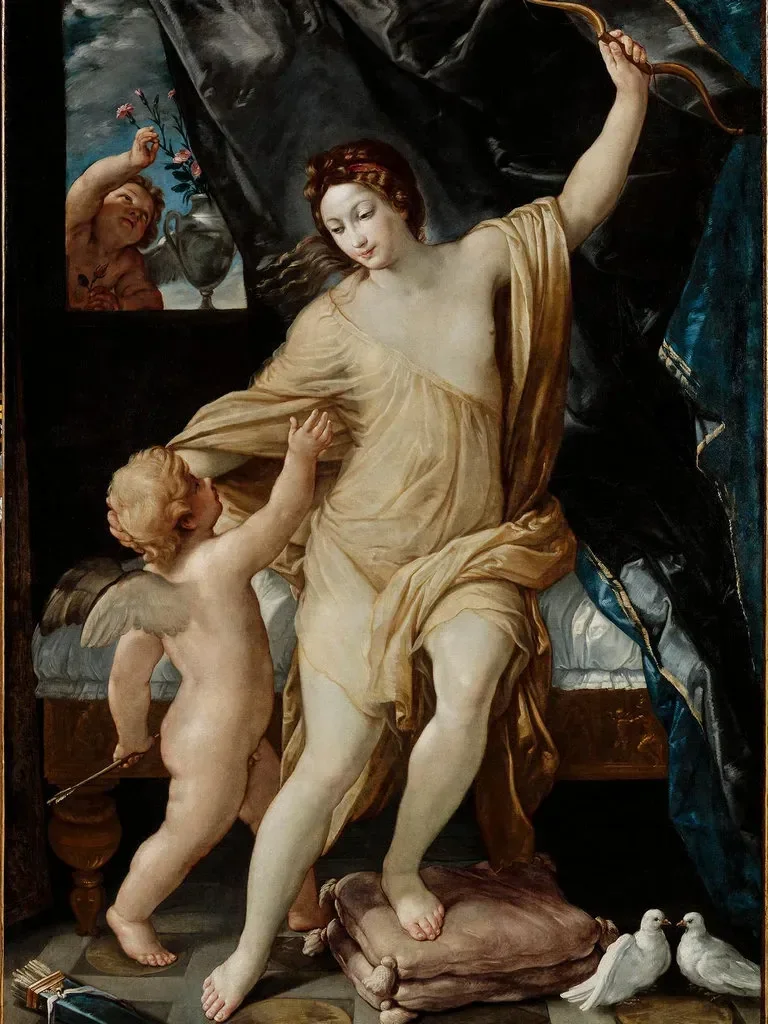
I. Fewer Books = Less Sex?
Here is a troubling set of facts about contemporary life:
People are reading fewer books than ever
The books that people are reading are primarily ‘romansty,’ aka smut, aka not literature
People are consuming more pornographic images than ever
yet
People, especially and specifically, gen-z, are having less sex
And they feel more uncomfortable watching sex scenes than previous generations
These trends don’t obviously belong together. Or do they? How can we be consuming so much sexual media, yet not be finding satisfaction? What’s the gap between these experiences? And to what extent is the question of lower literary interest related to this incongruency?
Well, the decline of reading and the rise of pornography are not directly correlated phenomena. But, they are both symptoms of the same cultural shift away from imagination as the principle driver of desire. And I want to posit to you that the erotic and pornography are, in fact, opposites. And that classic literature is more erotic than pornography. Because the erotic effect is not produced by increasing explicitness; it’s produced by exploring the structure of desire. We have confused arousal with desire. Pornography arouses, yes, but it is not inherently erotic. The consequence of this confusion is that the way we understand intimacy, love, and sexual connection is progressing towards a deathly, barren landscape––both with respect to erotic experiences and our capacity for imagination.
Psychotherapist and author Esther Perel argues that animals engage in sex as a procreative, instinctual urge whereas humans transform this experience through their imagination and creativity to create an erotic life. So sex, in its most basic sense, is the physical act that leads to reproduction. Animals procreate, humans are animals, therefore we also procreate. However, humans also experience Eros, the Greek concept that denotes passionate, romantic, and/or sensual love. The word ‘erotic’ derives from the Greek ‘eros.’ In Greek myth, Eros appears in two different versions. In the earliest creation myths like Hesiod’s, Eros is a primordial god that emerged at the dawn of creation alongside Chaos and Gaia. (There are other creation myths that have slightly different versions of this story but the essence of Eros being one of the foundational primordial beings is not what’s in contention). Together, they drove the generation of new life in the cosmos. But Eros is also the mischievous, winged son of Aphrodite with Ares (the god of war, with whom she betrays Hephaestus). In this incarnation, his enchanted arrows induce unpredictable love of uncontrollable desire in both gods and mortals. Anne Carson in Eros the Bittersweet, tells of how the Greek eros “denotes ‘want,’ ‘lack,’ ‘desire for that which is missing’” (10). And she writes that “human desire is poised on an axis of paradox, absence and presence its poles, love and hate its motive energies” (11). Carson’s emphasis on the incomplete, on the importance of the presence of absence, is key to understanding the importance of the erotic. The erotic does not lie in the realm of the physical, or at least not entirely. It occupies a mental space, and requires imagination. Audre Lorde, in her essay “Uses of the Erotic: the Erotic As Power,” defines the erotic as “a measure between the beginnings of our sense of self and the chaos of our strongest feelings…. [It] is not a question only of what we do; it is a question of how acutely and fully we can feel in the doing.” The Erotic, according to Lorde and Carson, is an energetic aperture with dimensions––of anticipation, playfulness, and curiosity, which must transcend the physical machinations of the sexual act.
The mystical view of eroticism is vast, and vital. Historically, eroticism was seen as a source of vitality, aliveness, and renewal. As the 13th-century Persian poet and Sufi mystic, one of my favorite poets alongside Seamus Heaney and Rilke, writes:
Last night,
I saw the realm of joy and pleasure.
There I melted like salt;
no religion, no blasphemy,
no conviction or uncertainty remained.
In the middle of my heart,
a star appeared,
and the seven heavens were lost in its brilliance.
His conceptualization of the realm of joy and pleasure holding such deep power over the self can be easily compared to the Greek myth that places Eros alongside chaos and chronos/time as major birthing forces of the world. The imagery of the speaker “melt[ing] like salt” echoes many of the first Greek poets whose work was written down, like Sappho and Pindar, the latter who, for example, writes: “I melt like wax as the heat bites into it” in his depiction of his reaction to a beautiful boy (Carson 15). Indeed, Carson states that “[i]n Greek lyric poetry, eros is an experience of melting” (39). This viscosity is inherent to the nature of eros, for in the sexual––physical or energetic––union of the Self and Lover/Other, one loses the “integrity and control of one’s own body” (41). Melting “like salt,” however, is a peculiar image. While it is easy to conjure, by way of candles or Descartes, an image of Pindar’s wax melting, salt only melts into a liquid at 801ºC. That amount of heat entails an outrageous particle speed. It does, unsurprisingly, stir up a star in the middle of the speaker’s heart that causes the seven heavens to lose their brilliance. Rumi points to a destructive and otherworldly force contained within himself and his moment of pleasure. Salt also, however, freezes or dissolves when it comes in contact with ice, for it dissolves into sodium and chloride ions that disrupt the bonds between water molecules that dissolves it into a liquid brine. In the erotic act of joyous union, either––or perhaps necessarily both––in explosion and dissolution of self does the lover receive their ultimate pleasure, consummate their desire. Yet, as Rumi points out, in the end there is also a loss. The heavens are lost, if just momentarily, which brings us back to Carson: “If we follow the trajectory of eros we consistently find it tracing out the same route: it moves out from the lover toward the beloved, then ricochets back to the lover himself and the hole in him, unnoticed before. Who is the real subject of most love poems? Not the beloved. It is that hole” (30). “Seeing my hole [as in lack], I know my whole” (33). Like desire, creativity arises from the play of absence and presence.
II. Desire and Creativity
Desire and creativity are deeply intertwined; sex and creativity are also deeply intertwined. Creativity, according to Perel, involves stepping outside of existing boundaries, being non-linear and expansive so as to create pathways of connection between nodes of information that are not obviously related. It is about transcending the typically defining rules of the dimensions in which we exist in order to create a new reality. I like this definition of the creative because it encompasses things like painting, storytelling, and even Newton’s discovery of calculus. While Perel cleaves a sharp gulf between productivity and eroticism, the former is an incredibly common part of definitions of creative or artistic genius. Creativity, according to a common interpretation of Kant, is “the ability to produce works that are not only ‘original’—since ‘there can be original nonsense’—but also ‘exemplary’ (Kant 1790: §§43–50 [2000: 182–197]). (Hills & Bird [2018] challenge this reading of Kant.) Although in psychological practice and experiments “creativity is often not defined” (J.C. Kaufman 2009: 19) psychologists usually agree with Kant that creative products are not only new, but also valuable in some way. Though they variously express the product’s value in terms of its being “useful”, “effective”, “worthwhile”, “fit”, or “appropriate to the task at hand.” The emphasis on the product, or endpoint of creativity, however, transfigures creativity into a commodity; valuing artistic expression for its output reduces products of the human imagination and creativity to tools of “value extraction,” a consequence of the capitalist set-up of many western societies. Just as the inherent value of erotic interaction lies not in the ending, so the importance of creativity ought not to be entirely about the final product.
III. The Pornographic: Definition, Oppositions, and the Psychological and Ethical Consequences of its Visual and Written Manifestations
This is where the pornographic comes in. The pornographic is the opposite of the erotic. Lorde argues that “pornography is a direct denial of the power of the erotic, for it represents the suppression of true feeling. Pornography emphasizes sensation without feeling.” In The Pleasure of the Text, Barthes perfectly describes the difference between the pornographic desire and the erotic desire. The erotic, he suggests, consists of absence rather than presence. He writes : “it is intermittence which is erotic: the intermittence of skin flashing between two articles of clothing (trousers and sweater), between two edges it is this flash itself which seduces, or rather: the staging of an appearance-as- disappearance” (10). Pornography is defined as “any written, visual, or audio material—such as photographs, videos, or books—that depicts sexual behavior or nudity with the primary intention of causing sexual excitement.” It is a transparent representation of sex that aims to arouse and satisfy desire as quickly as possible. It is formulaic, often unimaginative, and about the end goal, namely, orgasm. While the erotic is expressly not a task-oriented experience––even if it is a central part of the sexual experience that does have an express end––modernity, especially pornography, has narrowed the erotic to its basic sexual function. In its adjectival form, pornographic, has also come to carry deeply negative connotations; when something is pornographic it is violent, it is vulgar. Lorde encapsulates it well when she writes that the erotic, when turned conflated with the pornographic, is “made into the confused, the trivial, the psychotic, the plasticized sensation.” context of its creation. As an industry, adult film platforms aim to keep users on them for as long as possible, keeping engagement and consequently profits as high as possible. This aim is not, of course, dissimilar to any online platform whose revenue depends on amounts of user engagement for profit.
The main opposition against pornography comes from moral and religious conservatives who argue that it should be banned purely because its obscene, sexually explicit content morally corrupts––I presume they speak of all parties involved: viewers, actors, producers, etc. In this view, access to pornography should be banned due to its morally corrosive properties. Even those who oppose censorship of pornography tend to agree that, especially violent and degrading pornography, is not particularly valuable, inherently or instrumentally. The tension of that stance is conveyed perfectly by the quote “I disapprove of what you say, but I will defend to the death your right to say it,” commonly misattributed to Voltaire, actually a depiction of Voltaire’s liberal position by Evelyn Beatrice Hall. In other words, the principle is that “mentally competent adults must not be prevented from expressing their own convictions, or from indulging their own private tastes, simply on the grounds that, in the opinion of others, those convictions or tastes are mistaken, offensive or unworthy.” However, how much compartmentalization can we afford a pornographic experience? That is, What is the relationship between representation and reality?
A former adult film actor said that “there is nothing sexual about porn.” I take that to mean that, on its surface, we understand that pornography is theatre, it is a performance between consenting agents getting paid for their acting––ideally, there are many problems with the ethical practices within the industry of pornography. But it’s naive or disingenuous to overlook the content of what is being produced. In Aristotle’s Poetics, he discusses how mimesis––the imitation and representation of our world in art––is a natural human instinct and a vital learning tool ( Metaphysics. A.1.980a21.). While Plato looked down on mimesis in the Republic because he believed that the world in which we live already comprises a cavernous imitation of the world of Forms, Aristotle presents mimetic art as a way in which we bring order, meaning, and understanding to our actions. There are philosophical disagreements with that and a general understanding that art also parodies, distorts, and satirizes its depictions of reality. Nonetheless, the representation of sexual relations seems to occupy a different space––where philosophical pondering over it is all good and well, but when the deed is done, when the porn is watched, people are changed. A 2017 National Library of Medicine study on the “impact of internet pornography addiction on brain function: a functional near-infrared spectroscopy study” presents empirical evidence that porn desensitizes its (ab)user to the pleasures of their lived-in worlds. They conclude that “The effects of internet pornography addiction on brain functional connectivity in the prefrontal lobe exhibit characteristics similar to those of drug addiction.” The issue of the convergence between representation and action grows in dimensionality.
III. What Happens In Porn Doesn’t Stay in Porn
This lasting impact, the looming effect, suggests that the way we fantasize the world can play a role in how we configure the world. A 2019 study concluded that porn affects people’s relationships, it tends to harm relationships when use is frequent, solitary, concealed, or mismatched between partners but can be neutral or positive when shared, mutually accepted, and openly discussed. The second bit of those conclusions is noteworthy; however, what I’m more interested in is the fact that––regardless whether the impacts are positive or negative––consuming pornography is not an isolated event that has no lingering effect on the person once they are done with consuming it. What happens in porn doesn’t stay in porn, it translates to our configuration of how the world functions and how we as agents ought to act and be within it. The opposite is also true. The emphasis in porn on the male ejaculation can be seen as a reflection of capitalistic ideals. Adult film is an industry that, like all industries, functions under a profit-driven model, which requires a clear, quantifiable proof of ‘pay-off’ and ‘product.’ And male climax––unlike female climax––is optimized to provide an immediate visual product. Male pleasure is thereby commodified, for it creates a standardized, easy-to-sell metric of sexual success. I mean, it’s euphemized as the “money shot…” Barthes writes, “the text of pleasure is not necessarily the text that recounts pleasures; the text of bliss is never the text that recounts the kind of bliss afforded literally by an ejaculation.” So, the erotic experience of pornography is being flattened and plasticized, to use Lorde’s term, as a result of the capitalistic context of its creation.
Additionally, as an industry, adult film platforms aim to keep users on them for as long as possible, keeping engagement and consequently profits as high as possible. The addiction to pornography not only causes large amounts of time, money, and personal attention to be devoted to the consumption of it, but also an escalation in the type of content. This consequence is worrisome for the same reason it is profitable: because humans are creatures that are easily habituated. Research provides evidence that humans can get habituated quickly and easily to repeated sexual images. Viewers whose mental reward systems are deeply dependent on pornography for sexual arousal become increasingly less aroused by the images that used to cause positive sexual responses. As a result, they seek novelty. This is not the case for all users. Nevertheless, if someone becomes addicted to pornography and needs to keep escalating the images’ intensity in order to feel pleasure, the troubling consequence for our scope is that it can translate into their erotic and romantic interactions in real life. And it is not just an issue with men.
The question of what arouses men and women is not as simple as: visual versus written erotic content. The socially popular claim that ‘men are visual and women are emotional’ is far too simplistic. A 2023 neuroimaging study found that visual sexual material activated attention, reward, bodily-sensation and visual-processing systems in both sexes––although men showed stronger activation in visual and prefrontal regions. Additionally, while heterosexual women may show physiological responses to both male and female sexual stimuli even when they report a clear subjective preference for men, their subjective erotic engagement depends more upon interpretation, perspective and situation. Another study showed that men and women become similarly aroused in response erotic stories although that women again showed arousal responses to a wider array of content. Specifically, while men were less aroused by female-dominant storylines, women were aroused similarly by both male- and female-dominated fantasies. A third study found that men’s response to erotic films was predicted by the female actor’s attractiveness, observational enjoyment and imagining themselves in the scene. That is, I think, the crux of where the clichéd understanding of the abyss between men and women’s sexual interest arises. Literature uniquely provides the reader the ability to inhabit the other’s consciousness. Unlike film which visually imposes a desired/desirable body in a singular way, the non-visual medium of (non-graphic-novel) text lets the reader inhabit the body of the desired. The reader can, without visual mediation, be the desired vicariously. The psychological distance from explicit imagery furnished by written erotica also lets women encounter erotic content from a safer place. This preference should not be surprising given the fact that women on average face greater physical and reproductive risks from heterosexual encounters––including pregnancy, sexual violence and physical injury. Nonetheless, while there both sexes respond to visual and imagined sexual stimuli. While men tend to show stronger motivation toward isolated, target-specific visual cues, women’s subjective arousal is more readily modulated by agency, identification, context and meaning. Interestingly, a review of 21 studies of queer women’s experiences on dating apps found that they also prefer the meditated experience and presentation of desire by way of the screen and digital distance.
The draw of men towards pornography is also a historically constructed reality; undoubtedly, it is compounded by the fact that mainstream visual pornography has historically aligned with the heterosexual male spectator. In a study that focused on female-produced erotica, women exhibited substantial and statistically similar genital arousal to both films. But they reported significantly greater subjective arousal to the woman-made film, while the male-made film produced more shame, guilt, and aversion. Male-oriented pornography consistently positions women as objects to be used for pleasure rather than agents whose pleasure is equally privileged as that of the man or men. This detail concretizes the difference between arousal and eros by demonstrating that while the female body may respond to explicit images, conscious erotic enjoyment deeply depends upon how the encounter is framed and whose desire organizes the scene. Women may therefore be no less responsive to images; they may be less responsive to images by a patriarchally-organized desire., Because women also read considerably more fiction, erotic-romantic narrative becomes a particularly compatible––and culturally sanctioned––medium.
This gap in visual pornographic media is what perhaps has given rise to the “women’s literature” genre and the smut economy. It appears to me that much of ‘modern women’s literature’ is not distinctively female-driven but is instead a form of mass-produced adult entertainment designed to profit from the ways women engage with erotic content. As Barthes writes “Pleasure’s force of suspension can never be overstated.” I think it’s true that contemporary publishing has learned to commercialize narrative forms that many female readers find erotically compelling. It seems that, like men when it comes to visual pornography, women can become increasingly desensitized to repeated depictions of explicit content. At the same time, increasingly explicit and intense forms of erotic fiction have found a substantial market among younger readers. To call this type of writing “women’s literature” is misleading. It does not necessarily promote female empowerment, nor is it explicitly for women. But because of historically constructed conditions that have made visual pornography for the male viewer such that women have resorted to finding their sexual fulfillment in reading. Nonetheless, both visual pornography and written pornography are largely profit-driven; neither are ultimately for the benefit of viewers/readers. There’s not only a gendering that the publishing industry has benefitted from classifying as women’s literature, but there is also an elitism related to the qualifier of literature.
IV. The Difference Between Erotica and Pornography
What is the difference between ‘erotica’ and ‘pornography’? As Grant Hudson writes, “contrary to some expectations, the difference doesn’t break down easily across educational lines — in other words, it’s not that educated people prefer erotica and uneducated people go for porn.” I don’t think it’s an issue of class. One commenter on The Guardian’s Ethical Conundrums page put the common misunderstanding as “erotica is brunettes in silk, pornography is blondes in nylon. Erotica is for nice middle class literate people like us, pornography is for the lonely, unattractive and uneducated.”
A book is not, by its nature of being a written cultural object, literature. This distinction comprises an age-old battle between literary fiction and genre fiction, which it is generally agreed that the former aspires to be ‘art’ while the latter aim to merely provide entertainment. This separation is worthwhile to uphold. There are explicit scenes in Sarah J Maas’ fiction such as A Court of Thorns and Roses and in D.H. Lawrence’s Lady Chatterly’s Lover. But one is ‘smut’ while the other is ‘literature.’ I, personally, believe that the latter is more valuable than the former as an educational experience. But reading does not have to be a purely educational experience. Much as we can choose to watch a documentary about the origins of the Cold War or Love Island, so we can choose to read literature or smut. Perhaps it is always more valuable to choose to read no matter what it is that we’re reading because reading is a valuable experience of honing and training attention in a world relentlessly seeking to fragment it. That may be true simply for the attention issue, but when it comes to engaging with true erotic experiences as well as educational experiences––which are expressly not mutually exclusive in my argument––smut cannot be part of that curriculum, so to speak. N.B. Sexual experience, in its many shades, should never be relegated to the ‘not valuable,’ especially in a world where a lot of sexual media is optimized for men and sexual pride is allocated to realms of the masculine and the heteronormative.
Lorde calls the erotic “a resource within each of us that lies in a deeply female and spiritual plane, firmly rooted in the power of our unexpressed or unrecognized feeling.” She writes that “we have been taught to suspect this resource, vilified, abused, and devalued within western society.” Maas’ style of book content is not this empowering focus on the erotic because publishing industries are merely capitalizing on the oppression that led to women’s deferral of pornographic content consumption to written media because “women have been made to suffer and to feel both contemptible and suspect by virtue of its existence” (Lorde.) Pornography is about the completion, the actuality; eroticism is about the novelty, and the potentialities. In its most formulaic products, narrative can become an optimized delivery system for repeatable gratification.
In The Pleasure of the Text, Barthes distinguishes between plaisir (pleasure) and jouissance (bliss)––the latter which in French also connotes orgasm. His distinction will help us uncover why it is that Milton, Bocaccio, and Amado feel erotic whereas Maas, Carlton, and Dixon feel pornographic. I want to allow that erotic literature can be very explicit and that smut can contain genuine emotional depth. But the formulaic nature of smut keys us into a fundamental difference. As Barthes writes,
The New is bliss…Whence the present configuration of forces: on the one hand, a mass banalization (linked to the repetition of language)—a banalization outside bliss but not necessarily outside pleasure—and on the other, a (marginal, eccentric) impulse toward the New—a desperate impulse that can reach the point of destroying discourse: an attempt to reproduce in historical terms the bliss repressed beneath the stereotype.
While smut uses narrative to produce arousal, it––like its visual cousin pornography––relies on formulaic renderings. It may be a text of plaisir, but not jouissance. Plaisir, for Barthes, is a comfortable satisfaction derived from reading familiar texts. It reinforces the reader’s ego, cultural identity, and traditional assumptions. He writes that “The pleasure of the text can be defined by praxis (without any danger of repression): the time and place of reading: house, countryside, near mealtime, the lamp, family where it should be, i.e., close but not too close.” Reading does give us a sense of privacy at the level of social interaction mediated by media. Watching pornography on the subway will––rightfully––elicit disgust by one’s fellow commuters. In modernity, unlike in Roman times, we have a social contract where the sexual is meant for private settings, and to violate that is to do violence on the others with whom one shares one’s space. Reading––especially nowadays with ereaders where their faceless faux-textured covers give nothing away of its contents––creates a private connection between narrative and reader. While someone may know that if someone else is reading smut and may feel uncomfortable, I would venture to say that the level of discomfort is exponentially lower than the public porn consumer. On the person-with-her-book level, Barthes argues that the text of pleasure acts as a transparent medium where the reader remains passive, seeking a logical resolution and emotional comfort. The banal passivity of this interaction is shared between visual and written media.
But the text of bliss, as we’ve established, constitutes an altogether different experience. Barthes, as he cites, is basing his idea of bliss on Lacan, when he defines jouissance in contrast with plaisir. Not only is jouissance new, not banal, but it also elicits a sense of discomfort. It, like orgasm, comprises an intense, rapturous, and perhaps violent, jolt that breaks through cultural and linguistic codes. As in orgasm, the sense of the boundaries of the self is threatened when one engages with a text of bliss. Aristotle says that “All men reach out to know.” Carson writes:
As you perceive the edge of yourself at the moment of desire, as you perceive the edges of words from moment to moment in reading (or writing), you are stirred to reach beyond perceptible edges––toward something else, something not yet grasped. The unplucked apple [referring to Sappho’s poem Fragment 105], the beloved just out of touch, the meaning not quite attained, are desirable objects of knowledge. It is the enterprise of eros to keep them so (109, my emphasis).
Eros exists and plays in the space between the here and there, the then and and now, the expressed and the withheld. Remember Barthes, it is the intermittence which is erotic. By relying on restraint and never fully allowing gratification, desire remains. Let’s look at Caron’s translation of Sappho’s “Fragment 105”
As a sweet apple turns red on a high branch,
high on the highest branch and the applepickers
forgot––
well, no they didn’t foret––were not able to reach
…
“Sappho begins with a sweet apple and ends in infinite hunger” (Carson 29). The insatiability of yearning is distinct to that of our modern-day addiction. The psychological and erotic tension exists only because this poem, along with swathes of other ancient Greek lyric poetry, showcases the process of pining rather than the climax. The imposition that delay is partially contained within the very nature of reading: one can’t get to the meaningful end of the sentence without reading what comes before. If you read the poem “as” then “reach,” you cannot be said to have read it. You cannot have understood it. You can, by contrast, scrub to the end of a pornographic video and observe the conclusions. “We cannot really say that time ‘is’ except in virtue of its continual tendency not to be” (Augustine, Confessions 11.14.17). The delay required to partake in the process prior to achieving bliss is only part of the erotic experience, however.
The other part of the experience is the space, or, in other words, the aesthetic of desire. Carson writes that ‘imagination is the core of desire. It acts as the core of metaphor. It is essential to the activity of reading and writing’ (77). Modern explicit media actually kills desire by removing imagination. Reading, in its essence, is an act of imagination and creation that is deeply erotic. We look at black marks on a white page written by someone else about other someone elses and in our own minds use their words, sounds, and phrases to birth images and stories. It is a special kind of magic, erotic magic. As Montaigne wrote, “My Page makes love, and understands it feelingly” (1603 bk. 5, ch. 3). In Homer’s diction and usage, the same verb mnaomai denotes ‘to give heed, to make mention, to give thought’ and ‘to court, woo, be a suitor’ (Carson 108). We, as readers, are wooed into the world by the act of reading in addition to what we read. And not only do we create images, but we also create meaning. While “the words we read and the words we write never say exactly what we mean” (109), we cannot neglect form as a massive part of meaning-making. The life-giving force of literature, to me, exists in the interaction between form and content that readers have to parse out. The erotic is encased within the form. Literature is inherently erotic, so too reading. Moreover, literature that also includes erotic elements uses arousal to produce meaning within desire, which, fundamentally, are ontological and metaphysical concerns.
Erotic literature chooses desire as its object of artistic exploration. Erotic narratives depict sexuality––not sex itself necessarily––but never without and/or symbolic transformation. Oscar Wilde said: “Everything in the world is about sex except sex. Sex is about power.” His anti-instinctual affirmation elucidates a fundamental aspect that distinguishes pornographic writing from erotic literature. When literature scrutinizes erotic interactions, it does so to also consider the nature and complexity of human subjectivity: relationships, identity, vulnerability, power, transcendence, etc. Smut, by contrast, employs desire as a rhetorical engine that drives the reader towards sexual gratification. This discussion of erotic literature as meaningful and important should not be generalized or overstated to a claim that because sex is a natural part of the human condition that a text would be incomplete without including. That is markedly false. I am writing about the case where a novel does, because it chooses to, include discussions and depictions of the erotic. There is, as Aristotle would point out, a ‘virtuous’ (I use that loosely) mean here between censoring all mentions of sex and only mentioning sex. We are talking about those literary works in which eroticism serves broader aesthetic, psychological, or philosophical ends. And there are various important uses of sex in narratives as well as explanations for the existence of erotic narratives.
Art liberates our unconscious desires. It elevates them into psychological and aesthetic experiences. Erotic art mediates its aim of producing sexual thoughts, feelings, imaginings, and desires by bifurcating its reader’s attention in asking the reader to also equally attend to aesthetic form such as language, meter, composition, style, and medium. It asks for its reader’s participation and thereby engenders agency within the reader. By contrast, pornography functions as a transparent representation (remember Barthes called the pleasure text transparent as well) that aims to satisfy desire as quickly as possible, making the viewer or reader a passive receiver. Erotic literature gives agency, autonomy, which is liberating; pornography removes it. Art can function as a liberating encounter for the unconscious of the creator as well as the viewer/reader. It may here be argued that pornography, in producing financial gain for its actors and producers, also provides an ilk of autonomy––financial autonomy. Despite its opacity in terms of its labor conditions as an industry, it is a well-known fact that much of the industry is deeply exploitative, especially for women. There are innumerable reports of participants being filmed and photographed direct duress of male perpetrators. As one participant of an exploratory study of women’s experiences in pornography production in Sweden testified: “In this industry, you’re no longer human.” Humans are generally understood to be differentiated from their animalistic counterparts as a result of our free will, our choice, our autonomy. But what about platforms like OnlyFans? I believe that these platforms operate on a false sense of empowerment. While they purport to empower women by allowing them to take agency over their sexuality and monetize it on their own terms, the nature of this digital sexwork platform differs little from ages-long the capitalistic and patriarchal exploitation of young women. The narrative of self-empowerment that OnlyFans promotes can be much likened to the narrative that Humbert Humbert weaves of Dolores’ seduction of him in Lolita: false, and created by the person in power who benefits from the vulnerable’s participation—which is never the vulnerable party herself. The appearance of autonomy is not the same as the thing itself, which is what art provides.
V. Erotic Art and Literature
Art allows the unconscious symbolic material that resides within us as a result of our personal and societal experiences to transform into conscious aesthetic experience. Reading erotic, engaging with the interstices––the said and the unsaid, the meaning of the content and that of the form, the inner and the outer––is the process by which these unconscious structures of desire become intelligible. I would venture to say that many artists––writers, painters, sculptors––have had the experience of beginning a creative work where ideas that you’ve never thought consciously about before pour out faster than your hands can work them into legible letters or well-mixed colors. What is felt becomes externalized through the erotic power of creation. Remember Lorde, “pornography is a direct denial of the power of the erotic, for it represents the suppression of true feeling. Pornography emphasizes sensation without feeling”(my emphasis). Art privileges both sensation and feeling by attending to what is hidden. We can go into a lot of Freudian stuff here, but I prefer William Blake. Blake’s text The Marriage of Heaven and Hell, is where, according to W.H. Auden “the whole of Freud’s teachings may be found.” Blake human freedom as an expansion of imagination and creative energy––which is what Carson and Lorde would equate to erotic energy: “Energy is an eternal delight, and he who desires, but acts not, breeds pestilence.” There is freedom in pursuing our delight, Blake tells us.
In Homo Ludens, Johan Huizinga discusses the fundamental nature of play as an animalistic and human activity. He writes that “play is older than culture, for culture, however inadequately defined, always presupposes human society, and animals have not waited for man to teach them their playing” (1). We can use Huizinga’s concept of play and Scott G. Eberle’s outlining of the six elements of play not only to concretize our distinction between the erotic and the pornographic but also to explain how the erotic designs meaning within and by way of desire. Play and the erotic share the requirements for uncertainty, anticipation, reciprocity, symbolic action, voluntary participation, and imagination. And they are centered around experiencing joy, and having fun. As Lorde writes:
Another important way in which the erotic connection functions is the open and fearless underlining of my capacity for joy. This is one reason why the erotic is so feared, and so often relegated to the bedroom alone, when it is recognized at all. For once we begin to feel deeply all the aspects of our lives, we begin to demand from ourselves and from our life-pursuits that the feel in accordance with that joy which we know ourselves to be capable of.
Erotic desire is fundamentally ludic. Pornography is not. Examining the playful structure of desire by way of form and content creates erotic literature. Ovid’s Ars Amatoria is deeply playful. Throughout the book of poems, Ovid alludes to and obliquely discusses sexual acts, but his foci are on everything but––everything that leads up it (hopefully, for the poet). And the speaker positions himself as a guide, explaining not only how to ‘get the girl,’ but to correctly interpret the signs and symbols of desire throughout the courting process. In I.I., he cheekily says: “listen to the expert poet: / I sing true: Venus, help my venture! / Far away from here, you badges of modesty, / the thin headband, the ankle-covering dress. / I sing of safe love, permissible intrigue, / and there’ll be nothing sinful in my song” (28-33). The tone of the poetry is incredibly playful throughout.
And from the beginning we learn that Love is an art with rules that need to be learned and practiced. While sex may be a human instinct, eroticism is created in culture. Notably, some practices Ovid outlines around persistence and consent don’t resonate so well with modern readers; I believe they reflect Roman social norms and power structures rather than proffer timeless truths about love. We shouldn’t come away with a definitive rule book about modern courtship; we should keep with us his aesthetic insight that desire is mediated through play, performance, interpretation, and delay––with his near phenomenology of flirtation. Huizinga closely associates poetry with play:
Poiesis, in fact, is a play-function. It proceeds within the play-ground of the mind, in a world of its own which the mind creates for it. There things have a different physiognomy from the one they wear in “ordinary life”, and are bound by ties other than those of logic and causality (49).
Ovid is at formal play while discussing the playful elements of the erotic. Courtship is ludus described in the ludic medium of poetry. Moreover, in creating knowledge about the erotic further play. Huizinga again: “For archaic man, doing and daring are power, but knowing is magical power. For him all particular knowledge is sacred knowledge—esoteric and wonder-working wisdom, because any knowing is directly related to the cosmic order itself (105).” I don’t think we ought to relegate knowledge as magical power as something true just to archaic man. Contemporarily, knowledge and its creation are not mere byproducts of play, they are its very essence. When any individual plays––child or adult––they are engaging in open-minded exploration, experimentation, and problem-solving that leads to a deeper personal engagement with the world. Ovid is teaching the ‘rules of Love’ by way of play. Moreover, literature creates the space for pleasure in free use of words and ideas.
Literature, particularly complex and challenging literature, allows our minds to play and have free reign. As Benjamin McEvoy explains in his video about Gravity’s Rainbow, “the value of books like Thomas Pynchon’s Gravity’s Rainbow is that these books relieve the burden of being a soul trapped in a body that will die—a body that craves pleasure that eventually will be in a moment when pleasure can be no longer sought. These books relieve the burden of living.” Sex and death constitute the twin engines much of literature. Again Freud’s concepts of Eros and Thanatos come in here, but the dialectic of sex/death allows writing to explore the most complex human aspects that contain within them both total fullness and total emptiness, that deeply connect individuals and that drive them asunder. In life, we seek joy, or fulfillment. Ancient thinkers, from Confucius, Lao Tzu, and Zhuangzi in the east to Socrates, Plato, and Epictetus in the west, treated philosophy as a way to transform how we live, help us question life’s assumptions, and achieve mental clarity so we can live good and happy lives. That’s no longer the case in modern and contemporary philosophy, but eudaimonistic theories, or the idea that one can create and follow one’s own version of that if it be internally consistent, is one of the best things philosophy gives us––in my opinion. And erotic literature brings us life, and more life. And also death?
Perhaps that’s why a lot of erotism has been associated with religious experience. Augustine’s Confessions, itself heavily influenced by Platonic philosophies and which in turn became the text upon which much western exegesis is based, shows discipleship as a romantic pathway. As James K.A. Smith writes, “We are what we love, and as creatures made in the image of God, humans are characterized by an essential desire that defines who we are: at the heart of our being is a kind of ‘love pump’ that never shuts off.” On Augustine’s view, it is impossible for humans not to be lovers, it is impossible for us not to experience desire. However, with our God-given free will, we can choose what we love. Of course, he would say we ought to direct that experience unto God. We let part of our animalistic beings die when we transfer that erotic energy into our religious attention. However, we ought to ask also the other version of this question: why are sexual and religious experiences similar in structure? Death, of course. In French, “la petite morte,” the little death, is an idiom for orgasm. The transcendental experience of connecting with Source or God, is something beyond the confines of what we’ve experienced as the quotidian, wherein we experience ourselves within pretty well-defined units.
When we have an erotic experience or a religious experience, we lose our sense of self. Anne Carson writes that “the experience of eros as lack alerts a person to the boundaries of himself, of other people, of things in general. It is the edge separating my tongue from the taste for which it longs that teaches me what an edge is” (30). Georges Bataille agrees with her. He states that “we are discontinuous beings, individuals who perish in isolation in the midst of an incomprehensible adventure, but we yearn for our lost continuity.” On his view, discontinuous means a being that exists as a separate, bounded individual that is born alone, lives alone, and dies alone. At the moment of religious or sexual transcendence, we often experience moments of profound union. But for Bataille, we remain irreducibly distinct––for Carson, that knowledge of simultaneous contradictory feelings is what creates eros. We speak of ‘becoming one,’ and, in Plato’s Symposium, have Aristophanes claiming that humans were originally powerful, spherical beings who were so powerful they started rolling themselves up Mount Olympus. To prevent that, Zeus split them into two halves, leaving each person to spend their lives searching for their other half in order to return to wholeness. However, we ought to (1) take into context that Aristophanes was a comedic playwright and that (2) that returning to this ‘whole’ is an impossibility, and the tension that maintains that distance is eros. We desire the beloved and we ache because the beloved can never be fully possessed or fully known. Perhaps the same is true of God. That paradox––simultaneous intimacy and irreducible otherness––is one of the reasons erotic love has been such a fertile subject for centuries of literature.
VI. The Many Revelations of Eros
And that transformative, if brief, potentiality of eroticism holds a unique power, which amplifies when it is written down. Classical literature, as well as some contemporary literature, uses the erotic as a means to explore other topics. Although Professor Steven Mintz writes that “earlier erotic works—Ovid’s Ars Amatoria, Boccaccio’s bawdy tales, libertine pamphlets mocking clerical hypocrisy—used sexual explicitness to satirize, provoke, or ridicule. Sex was a weapon or a joke,” I believe that is overly simplistic. The erotic is always examined in plurality. The major works that made me think of writing this essay in the first place are Ovid’s Ars Amatoria and his Metamorphoses, Milton’s Paradise Lost, and Boccaccio’s The Decameron.
i. Eros as Transformation & Ethics
In the Metamorphoses, Ovid demonstrates desire’s profound transformational potential. In classical mythology, one of Eros’ portrayals is the mischievous, winged son of Aphrodite with Ares (the god of war, with whom she betrays Hephaestus). In this incarnation, his enchanted arrows induce unpredictable love of uncontrollable desire in both gods and mortals. In the Metamorphoses, all the stories are, of course, about transformation. And many of the stories are about the power of desire, particularly uncontrolled desire from those in power, in this case, the Gods. One of the stories that always remains with me is that of Apollo and Daphne. After Eros shoots Apollo with one of his arrows, Apollo becomes enamored with the nymph Daphne. Daphne runs away from him, in fear. The chase scene is suspenseful and pitiful, and there’s a tragic element in that the reader knows that Apollo catching up to Daphne is inevitable; by his nature as a God, he is inherently more powerful. But, just as Apollo catches up to her near her father, Peneus’, river, she calls out to him and to Gaia––the earth goddess––for help, and she transforms into a laurel tree. Desire cannot be forced, it is an act of autonomy and liberation. When someone’s autonomy is caged in by greater forces, including someone else’s lust or obsession, desire becomes impossible. While Apollo is the God of music, poetry, art, prophecy, truth, archery, healing, and the sun––while he embodies divine order––he can be deeply transformed by desire into a rather monstrous being. Apollo coronates himself with laurels, to keep Daphne with him; however, the essence of the nymph as she was previously embodied is gone. In her absence, she remains present, but only as part of Apollo’s decoration. This tale shows why the erotic is so feared––because it is so powerful. Exploring the erotic requires us to look deep within ourselves and consider our desire, our pleasure, our emotional aliveness. This contemplation threatens systems of control, it forces us to break rigid boundaries, and exposes deep personal and cultural values.
i. Eros as Politics & Ethics
Let us speak now of Milton. Before the Fall of Adam and Eve, when they eat from the tree of knowledge and specifically gain moral knowledge, Milton paints desire itself as innocent. In the age of puritanism wherein Milton wrote, his depiction of Satan and Adam and Eve before and after the Fall was highly iconoclastic. Within the debate of whether Adam and Eve make love before the Fall, I believe they do. Because of Milton’s hesitational language, however, such as “I weene” (a.k.a. “I assume” or “I guess”), in conjunction with his euphemistic choices of “rites” and other words that don’t explicitly say ‘sex’ scholars debate whether this intimacy was merely spiritual or physical. I wonder if that’s besides the point. The body, both physical and spiritual, becomes a way to connect with God, with the Divine. Adam and Eve are described as wearing their “naked majesty” without shame, as “then was not guilty shame.” They appear as “lords of all” and are viewed as the loveliest pair ever seen. The protagonists are described as being in constant Edenic bliss––enjoying every bit of their life: the paradisiacal beauty that surrounds them, the gratification they receive from working the land and gardening, and the bliss they receive from one another. This Eden is teeming with life, with the power of eros. And the dynamic between Satan and the lovers explores the ultimate gap that creates desire.
Before the Fall of Adam and Eve, when they eat from the tree of knowledge and specifically gain moral knowledge, Milton paints desire itself as innocent when existing in a relational context. Milton believed that the household was the foundation of the commonwealth, for the household was a miniature state. When desire is governed by love and obedience is given freely, things are good. Satan is ruled by his negative passions, which are a result of his banishment from God’s world, from his deprivation. And, it is only when Eve becomes separated from Adam that she is persuaded to indulge in the fruit of the Forbidden Tree. Once they both eat of the fruit, they obey out of fear and each attempt to rule over the other. Power is now coercive. After the Fall, eros and passion doesn’t lead to freedom and enjoyment, it causes shame, guilt, hatred, envy, because the possession of moral knowledge led to the deprivation of pure mutuality. The shift in the perception of sex in Paradise Lost asks a political and ethical question: what is the proper relation between two free persons? Desire functions as an inquiry into order, hierarchy, ethics, commonality, theology. How, if it all, can we freely love each other and God?
iii. Eros as Hermeneutics
In Boccaccio’s Decameron, an erotic work that came three centuries before Milton, erotic narratives reveal how people can survive society, and the text is a use-case for how narratives can be arousing without being deeply explicit. The Decameron is a 14th-century collection of 100 short stories, told by ten young nobles over ten days fleeing the Black Death by residing in a countryside villa just beyond Florence. The tales vary from typical chivalric romances to deeply euphemistic recountings of sexual and non-sexual encounters between lovers in different societies. Its characters constantly navigate sociopolitical questions of the time, like reputation and class and marriage and so on and so forth. In Day III, Story X, Alibech, a naïve young woman, wants to become holy. She goes into the desert to live among hermits, and Rustico, a monk, becomes attracted to her and giving into his temptation he tries to get with her. He eventually convinces her that the way to “serve God” is to “put the Devil back into Hell,” the devil being his erect penis and hell being her vagina. Alibech, not knowing better, believes this is a genuine religious practice, and the two have enthusiastic sex until Rustico is exhausted and she goes to find someone else who can help her practice this ‘rite.’ When she arrives in town and explains it to the townswomen, the story spreads. In addition to it be just quite a hilarious––if manipulative––story, it demonstrates the instability of language and shows how eroticism can become hermeneutics. “Putting the Devil into Hell” means nothing sexually, until it means everything sexually. Rustico functions in an antithetical way to Apollo. His success results not from physical power but rhetorical power and a profound understanding and ability to manipulate social dynamics. The sexual act depends upon the deceptive presentation and incorrect interpretation of signs, which, in turn, elucidates how religion and eroticism operate through similar structures. Like rituals and symbols, and the joke works because religious language can be––quite easily, he shows us––redirected towards erotic meaning. Social life becomes theatre when identities are performed, which they are not only in the level of this story, but also in the overarching narrative of the Decameron itself. Each character takes his or her turn being the king or queen for that day and ruling over the stories told.
While porn could provide actors dressed as nuns or Adam and Eve, it’s providing bodies; its narratives are stale. Boccaccio and Milton are creating play-grounds of the mind. Thus, the greatest erotic literature uses sex as a method of philosophizing, of investigating, of knowing the world––desire forms the channel by which phenomenology, hermeneutics, epistemology, metaphysics. Curiosity is desire. The purpose of pornography is to end desire through stimulation. By feeding the fire of arousal, it burns the curious landscape around.
VII. Conclusion: Are We Window Shoppers of Sex? And Will We Ever Be Able to Get Back In the Store?
The existentialist philosopher Jean-Paul Sartre writes about how we are creatures of profound and fundamental freedom, who are often overwhelmed by our own freedom. As a result, we tend to live inauthentically, clinging to external structures and routines in order to avoid the anxiety and overwhelming paradox of choice that unfailingly accompanies the acknowledge that we are fundamentally free, that nothing is set in stone. We can draw a connection to the erotic through Lorde again, whom I quoted earlier:
Another important way in which the erotic connection functions is the open and fearless underlining of my capacity for joy. This is one reason why the erotic is so feared, and so often relegated to the bedroom alone, when it is recognized at all. For once we begin to feel deeply all the aspects of our lives, we begin to demand from ourselves and from our life-pursuits that the feel in accordance with that joy which we know ourselves to be capable of.
True eroticism is dangerous because of its overwhelming power and how it forces us to confront it. We surrender control to eroticism as we do our fundamental freedom, which is paradoxical but true. Living erotically is living authentically. Engaging erotically confronts us with truths and beings who cannot be reduced to images, commodities, or fantasies, and, in turn, exposes the limit of our selves and boundlessness of our worlds and capabilities to live within it. Pornography allows us protection, somehow. Rather than endure that anxiety, we can retreat into forms of desire that are conspicuously curatable and controllable for our convenient consumption.
Both creativity and the erotic involve leaving behind our self-definitions and consciousness to enter new spaces. As such, they are essentially analogous means of transcendence. They are also, in turn, acts of profound sovereignty and freedom. Lorde agrees, “When I speak of the erotic, then, I speak of it as an assertion of the lifeforce of women; of that creative energy empowered, the knowledge and use of which we are now reclaiming in our language, our history, our dancing, our loving, our work, our lives.” The great works of literature ask of us something like this. They refuse to let desire remain cheap. In Homer, Ovid, Dante, Shakespeare, Milton, Lispector, and countless others, eros is always revelation, always bigger than mere gratification. Centuries later, they are still erotic, in form and content, and when we read them, they remind us that chastity and puritanism do not sit at the opposite end of the experiential spectrum from pornography. The concepts that fill that blank can be many: attention, vulnerability, courage, eroticism, presence,––existence even. So read on, always, to learn more, always.