
The Paralysis of Postmodernism
I. What the Hell Even is Postmodernism?
Postmodernism is both important and destructive. On one hand, its theories about the instability of language, its suspicions about the totalizing narratives developed prior to the 20th century and its acknowledgement of the relationship between knowledge and power dismantled ideologies that seemed to previously pronounce absolute authority. It championed multiculturalism and subjective experience, and it profoundly influenced how we critique power structures today. However, deconstruction is also by nature destructive. And postmodernism’s heavy use of irony and extreme skepticism has led to a point where progress in literature has seemed to stagnate.
As Jean-François Lyotard argues (against his original arguments in his most famous piece The Postmodern Condition), the postmodern is not a “period” that comes after the modern; the postmodern is that which exists within the modern itself. Following him, I do believe that we are all, to some extent and inevitably, existing in a postmodern condition.
Postmodernism, as all good subjects for research and intellectual examination, never fails to rile up strong feelings with those familiar with it. As my Youtube channel has developed, I’ve made videos about modernism and why it matters today, about reading as an essential and living practice for making the world intelligible to us, and more. On almost every single video I’ve received some kind of comment about postmodernism.
Some people claim it doesn’t exist:


Other people do acknowledge its existence and do not like it:

And others prefer postmodernism over other literary movements:

None of these responses surprise me. As the name suggests, postmodernism came after modernism. Unlike modernism, which was a pretty positively defined movement––positive in the sense of defining not by way of a lack, postmodernism is a difficult topic because it’s such a vast intellectual movement. It is the movement wherein literature its attention turns away from an idea of a stable reality and depicting nuances and conflicts within it and towards broader and more philosophical scrutinizations of systems. It was majorly led by French philosophers like Lyotard, Jacques Derrida, and Michel Foucault––among others, of course. While it was centered around the ideas of these thinkers, postmodernism spread throughout the world. Its spread, however, seems like it caused somewhat of a paralysis.
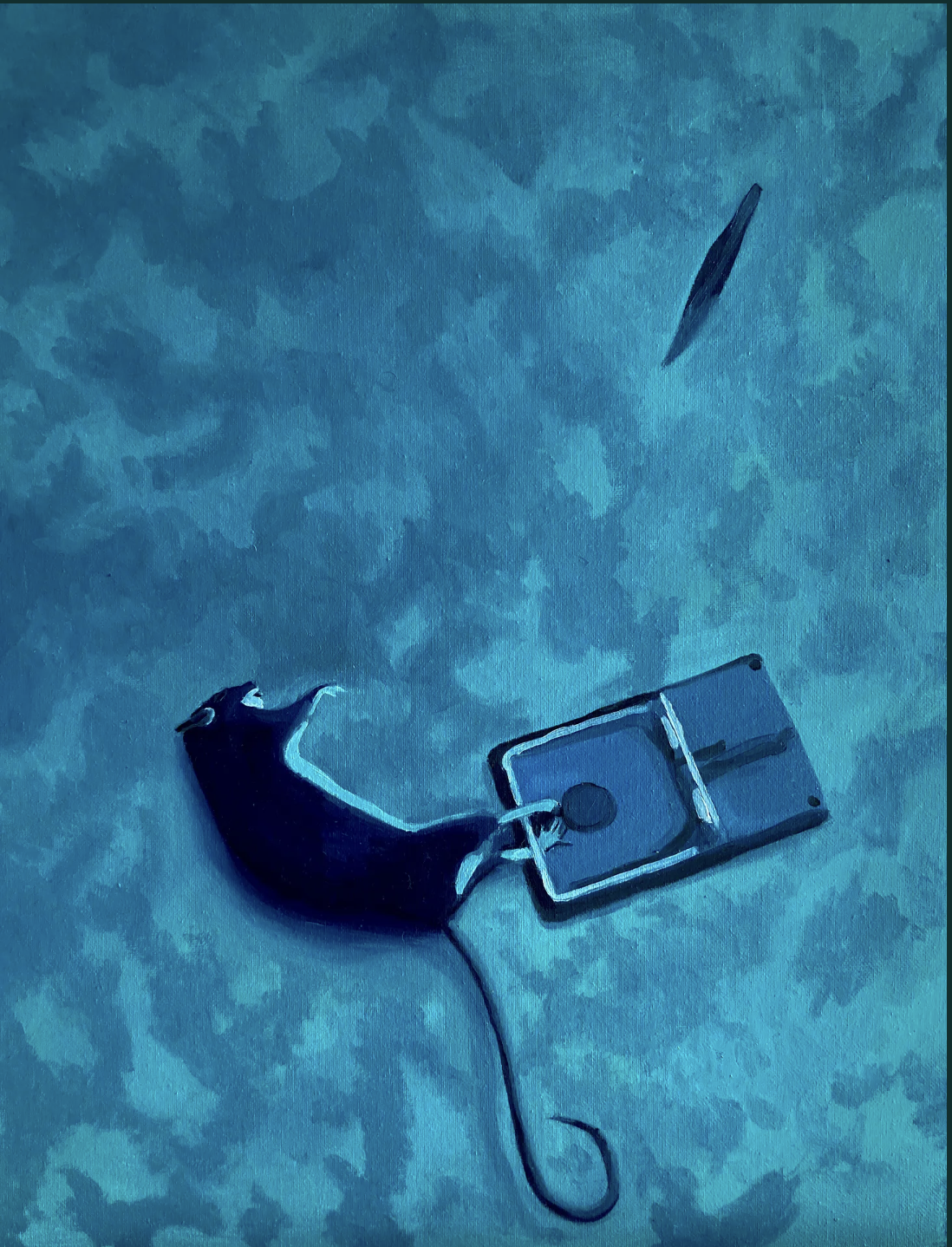
I believe that the paralysis of postmodernism is well encapsulated by Infinite Jest’s seemingly infinite references to cages. I think of the moment in the Boston Alcoholics Anonymous Chapter of where a person testifying says: “You are, as they say, Finished. You cannot get drunk and you cannot get sober; you cannot get high and you cannot get straight. You are behind bars; you are in a cage and can see only bars in every direction. You are in the kind of a hell of a mess that either ends lives or turns them around.”
Or Lamont Chu talking to Lyle, the hovering guru who sits on the towel dispenser, when Lamont says: “So I’m stuck in the cage from either side… There’s no way out,” and Lyle responds: “You might consider how escape from a cage must surely require, foremost, awareness of the fact of the cage...”
The testimony and conversation both highlight one of Infinite Jest’s biggest takeaways for me. Although David Foster Wallace wrote what I would consider an extremely postmodern book––which shows that there are evils or powers in the world that will deeply deconstruct our selves, our lives, our purpose, and our realities––it doesn’t pose an ultimately hopeless or pessimist picture. Wallace himself advocated for a deeper sense of hope and sincerity than some other modernists and postmodernists. The text repeatedly highlights the potential for upward spiraling or downward spiraling processions of their characters’ lives but leaves it ultimately ambiguous. This equivocacy, in turn, demonstrates that the modern world in which we live holds truths and realities and values that are what we make of them, and what we can make of them within its constraints. Perhaps that is just a flowery way to put the classic characterization of postmodernism as “everything is relative,” but I think the latter formulation is too reductive.
Infinite Jest attempts to reveal ways in which we can, in fact, become aware of the cage––a hopeful push in the direction of liberation. By the same token, however, it also asks: what happens when awareness of the cage becomes another cage?
I think the scene with Lamont Chu and Lyle (of which my newest video opens with an animation) perfectly illustrates the absurdity in which postmodern wisdom comes to us: enlightenment delivered from an impossible place.
After tracing the historical and philosophical conditions that led to the creation of postmodernism, asking what it actually accomplished, I want to discuss what discoveries are left after postmodernism’s critique of truth, language, and authority? Because I think there’s still a lot left.
II. What Conditions Created the Postmodernist Movement?
Philosophically, postmodernism is largely a reaction against the intellectual assumptions and values that came before it. There’s a large focus on the modern period in western philosophy (roughly 1600s-1800s), and specifically those views of Enlightenment philosophies that sought universal, objective truths.
With respect to literature—or, in the other words, the depiction of cultural philosophies, values, and assumptions—postmodernism harbored a deep distrust of grand, universal narratives like those posed in epics like that of Homer and realism, such as Tolstoy’s War and Peace. The text presents a world where history is meaningful and directional, and it conveys an argument about the nature of the drivers of history. Because following Hegel, after WWII, it became harder to believe in the progress of history.
While realism believed that reality could be represented, the postmodernists believed that the traditional means and metanarratives by which we order the world––which are represented in enlightenment and victorian era novels and also more broadly beyond them within culture––are lost in a postmodern condition. They also thought this true of Romantic novels (like Hawthorne’s The Scarlet Letter), and some might even say modernism (like Kafka’s The Trial). Although these works of course have nuances, at their core, they attempt to represent deep human truths, to explain ‘human experience.’ And postmodernism was suspicious of that entire creative project, thinking it naive.
In his 1979 text, The Postmodern Condition, Jean-François Lyotard called upon readers and writers to: “wage a war on totality; let us be witnesses to the unpresentable” and take the postmodern stance of an “incredulity toward metanarratives” (82). Lyotard highlights pretty well the idea of waging a word war, an intellectual war, against the structures of creation and knowledge that preceded the postmodernist period.
No human work is ever created in vacuum. So, the historical moment is deeply relevant, here, too––because like every other literary or intellectual movement, postmodernism was a reaction to its historical time. Let’s go for a quick run-down starting in the 20th century—this is of course a truncated history:
1900-1939 WWI & Interwar Period: the collapse of nineteenth-century optimism. Modernism is asking: How do we represent a world that no longer feels coherent? Modernism rejected realism’s aim to objectively depict the world. It focused on subjective experience, fragmented perspective, and stylistic experimentation. Postmodernism grew out of that. Modernist writers put into question the possibilities and means of representation, but still managed to come up with answers. But while modernism mourns the loss of unity, postmodernism questions whether unity was ever the right model in the first place.
1939-1945 WWII & The Holocaust: The Enlightenment narrative of inevitable moral progress becomes much harder to sustain following the horrors of the Holocaust and the worldly destruction. Literary critic and philosopher Theodore Adorno famously said, “To write poetry after Auschwitz is barbaric.” And Lyotard writes about how the development of “techno-science,” his term, can no longer be equated to “progress,” which is something that presented itself positively to humanity. Michel Foucault likewise questions the allocation of this statement to a camp of veracity as he wrote, across many texts, about how what a particular society accepts as ‘truth’ is not something that arises ‘naturally,’ so to speak, but something that is produced through systems of power. On his view, knowledge is not something that is neutral, because power is what produces and organizes it.
1947-1991 The Cold War proves Foucault right and compounds these issues. Postmodernism starts, in the 1960s or thereabouts. Lyotard writes that postmodern man is divided into two incommensurable parts: “one part confronted with the challenge of complexity; the other with the terrible ancient task of survival [which] is a major aspect of the failure of the modern project” (Norton 1387).
When it comes to survival, it becomes doubly difficult. People across the globe reeled from mental and physical traumas resulting from the world war while having to deal with the newfound atomic threat of existing in an age where sudden death looms at all times. On top of that, they were also unwittingly charged with the mental task to discern authentic artistic creation from weaponized arts. During the cold war, especially with the development of the CIA and in seeking to win the battle over Soviet communism, propaganda and mass media became central political tools. Movements like Abstract Expressionism turned into vessels of American culture wielded against the Soviets.
As a result, literary and cultural critic Jean Baudrillard suggests that culture itself began to feel fabricated, inauthentic, and every day people had to try to parse out what was genuine artistic expression from state-sponsored propaganda. He astutely foresaw the state in which a lot of modern society now exists, a state of hyperreality––where representations become more meaningful than reality itself. For example, in our day and age, people do not just photograph life; they live life in order to photograph it. As a result, the image rather than the reality itself becomes the organizing principle for reality.
This commodification and weaponization of art demonstrates how the Cold War fought not only on military grounds, but through fields of representation. Particularly, which country, its system, and its people represented freedom, progress, and the future. For example, on July 24, 1959, Nixon––then the vice-president––and Khrushchev attended the opening of The American National Exhibition in Moscow. The centerpiece of the whole exhibit, which aimed to showcase American consumer goods to the Soviet public, was a model home created by General Electric. As the two leaders toured the model, they exchanged a series of fervid statements about the merits of capitalism and communism, and the showroom modern appliances spontaneously transfigured into the perfect symbols by which each man made their point. This historical phenomenon is known as the “Kitchen Debate.”
Partially because of the increase in supply of products after the end of the second world war but also because of the propaganda war being propagated by the United States in order to establish its superiority over the Soviet Union, the cold war era produced some of the highest consumerism rates in U.S. history. As Emily Rosenberg writes in her chapter of Cambridge’s The Cold War Vol. III, “Capitalist-made consumer goods often seemed both the symbols and the substance of freedom…Image after image linked the rapid implosion of [communist] Soviet power to the triumph of [democratic free-market systems that created] consumerism.”
Television exponentially increases consumerism and the dissemination of propaganda. As Woojin Kim writes and cites in his article Television and American Consumerism in the Journal of Public Economics: “Historians and media scholars claim that the new medium of television, with its unprecedented advertising power, was a crucial catalyst that drew the American Dream away from ideals and instead toward a “national ethos of consumption” (Samuel, 2001).1 So, culture itself becomes commodified and mediated, and the digital age (1991-present) follows. Now, we are in the afterwaters of postmodernism, and, especially with the development of artificial intelligence, we are having to encounter, head-first, ‘reality’ or the world through screens, algorithms, and simulations.
Nuclear war and nuclear annihilation was an oppressing ubiquitous reality. However, for the everyday person, ‘nuclear war’ existed majorly or even exclusively through television broadcasts, warning films like Duck and Cover, sirens, and political speeches. According to Baudrillard, we could call that simulacra, for it is a simulated catastrophe that shapes everyday life without actually occurring. (Baudrillard’s theory is complex and interesting; however, I will not go into it in full. If you’re interested in hearing about why he thinks the Gulf War did not take place, I would highly recommend you read more of his work!)
In response to simulacra, propaganda, and oppressive government narratives, postmodern artists discarded the serious, earnest tone of the artistic movements that came before it. Instead, they adopted ironic stances, and embraced parody, pastiche, and mockery to respond to and navigate a world that felt fundamentally chaotic and relative. So, it’s plain to see how and why the state we are in is very postmodern. Before this era, (generalizing here) art had generally arisen out of a serious and genuine desire to depict something about the world. Movements and artists took themselves and the world they lived in very seriously; art was perhaps always political, but made by people seeking to authentically represent something they care about. But when it became so deeply politicized––and perhaps more gravely a method of mental manipulation––it’s easy to see how a culture can devolve into one suspicious of the principle of authenticity in the first place. So began the era of irony, whose feelings and suspicions we have inherited today.
III. What Did Postmodernism Actually Accomplish?
Modernist literature was already presenting a skepticism towards grand, unifying narratives and employed fragmentation in form, voice, and content in its depiction of individual and social crises.
Let’s look at the second stanza in T.S. Eliot’s The Wasteland, for instance:
What are the roots that clutch, what branches grow
Out of this stony rubbish? Son of man,
You cannot say, or guess, for you know only
A heap of broken images, where the sun beats,
And the dead tree gives no shelter, the cricket no relief,
And the dry stone no sound of water. Only
There is shadow under this red rock,
(Come in under the shadow of this red rock),
And I will show you something different from either
Your shadow at morning striding behind you
Or your shadow at evening rising to meet you;
I will show you fear in a handful of dust.
The first images question what it is that can grow out of this “stony rubbish,” which reminds me of Yeats’ final lines in “The Second Coming,” our classic modernist poem, where he writes
“now I know
That twenty centuries of stony sleep
Were vexed to nightmare by a rocking cradle,
And what rough beast, its hour come round at last,
Slouches towards Bethlehem to be born?”
The phrase “son of man” also gives another aligning allusion when we think about Jesus as the ‘son of god’ who is supposed to be the figure in the second coming but is instead replaced by this rough beast. What the son of man must face now is a “heap of broken images” and death and a lack of home and comfort at every turn. We cannot turn to the natural world as “And the dead tree gives no shelter, the cricket no relief, / And the dry stone no sound of water.” We have no place to live, no friends to listen to, and no nourishment. The shadow offered by the red rock is not a shelter, but it is something. It symbolizes the poor excuse that the post-WWI world offers to its inhabitants. While it is a deceptive shelter, the sheer fact of its existence shows that it was not total annihilation. And the speaker invites the listener into the false-shelter to show them something distinct and unnatural compared to the inevitable natural progression of their shadow in the sun’s traveled arc. While it is “fear in a handful of dust,” negative feelings associated with the remnants of the world that was there before, there is still something to show.
Indeed, meaning, albeit obscured, still exists in modernism. By contrast, postmodernism destabilizes the belief that there is a single world to be lost. Let’s take the opening passage of Thomas Pynchon’s Gravity’s Rainbow,
“A screaming comes across the sky. It has happened before, but there is nothing to compare it to now. It is too late. The Evacuation still proceeds, but it’s all theatre. There are no lights inside the cars. No light anywhere. Above him lift girders old as an iron queen, and glass somewhere far above that would let the light of day through. But it’s night. He’s afraid of the way the glass will fall––soon––it will be a spectacle: the fall of a crystal palace. But coming down in total blackout, without one glint of light, only great invisible crashing.”
Pynchon’s fragmented imageries go back and forth between the protagonist’s desire for light and imaginings of what his situation would be like if there were light and his acknowledgement that we are past the point of where light is even a possibility. From the beginning we are told “it is too late,” yet the novel continues for another almost 800 pages. Light, here, of course functions as a symbol for knowledge, or truth, perhaps. Alongside feeling this desperate desire to experience things in a known world and his fear of the current darkness exists the incredibly pressing and urgent acknowledgement of imminent destruction: “But coming down in total blackout, without one glint of light, only great invisible crashing.” This fear is existential on two levels: Slothrope is literally fearing for his life (his existence) in the expectations of the incoming “screaming across the sky” and he is fearing for his knowledge of the world, too, how the world exists in his mind. And Pynchon tells us that the measures we’re taking are useless, they dole out a sense of comfort perhaps, but it’s fake: “The Evacuation still proceeds, but it’s all theatre.” Theatre is the representation of the human world, but it is unreal by nature.
I’d also like to comment that there’s something to be said about the fact that the greatest works of postmodernism tend to be novels. Besides a couple poems and poets, notably John Ashbery and his extremely lauded collection “Self Portrait in a Convex Mirror,” when we think of postmodernism went tend to think of novels: Gravity’s Rainbow, Infinite Jest, If On a Winter’s Night a Traveler, The Unbearable Lightness of Being, and so on.
I think the novel became the postmodernist form for a couple reasons. Poetry can be long, but good poetry always tends to center around one main image or idea. Novels, on the other hand, are prolific, which if you’re talking about ever expanding senses of representation, then the novel is the way to go. Also besides visual media, prose is the written type of media most consumed by the general public, so if one is going to make a pastiche or parody of it, prose feels more appropriate.
So postmodernism accomplished the representation of this intellectually, culturally, and emotionally difficult moment. Things aren’t as hard as they were before during the wars; there aren’t rockets screaming overhead, but during the Cold War there are threats of them. And the invisible, which allows our own imaginations to push themselves into their most fearsome corners, is scarier than the visible. The silent threat and invisibility of the V2 rockets before their utter destruction and devastation represents that in Gravity’s Rainbow. And in addition to the fear of an invisible external enemy comes the terrifying recognition that the enemy might be within; that the consumerism that’s being pushed on us, that we’re literally and figuratively buying into, is our own government manipulating us into being pawns for their ideology and politics––which Pynchon does, too, I think. I don’t believe the narrator in Gravity’s Rainbow is on our side as readers.
And what else do we do with the recognition of those horrors? We laugh. While Gravity’s Rainbow has moments of incredible tension, horror, and emotion, the whole story is also about a man’s paranoia about his erections and their relationship to rocket strikes.
IV. To Laugh in the Face of the Absurd
‘Crazy’ protagonists like Hamlet, King Lear, and Lenz laugh at themselves, to the discomfort of others, and for them all, laughter is the response to encountering the dark and meaningless abyss. Postmodernism takes the power of this laughter from their protagonists and places the burden onto it.
Critic René Girard argues that laughter, like tears, can act as a true Aristotelian cathartic experience in tragedy because catharsis includes “both religious purification and medical purgation” (Girard 813). This kind of tragic-cathartic laughter is an emotional and physical manifestation of the crisis of the subject. Laughter also creates a deeper sense of crisis because, as a paroxysm, it threatens the autonomy and self-possession of the one who laughs uncontrollably (819). The irony and humor, then, is reflexive: it ought to bring the reader to an uncomfortable laughter, where we purge ourselves while realizing our paralyzed state: we are bound to the systems of signs, institutions, narratives, and technologies that mediate reality before we ever encounter it. It is inescapable and always already present in every act of communication, which ought to connect us to other people and the world.
So, postmodernism introduced an ironic attitude towards truth, and a general suspicion towards any total explanation, and it articulates the modern crisis of the subject in often deeply resonant ways and it uses literary form to represent it.
However, in elucidating the problems contained within the previous philosophical and ideological configurations of the world by deconstructing them, postmodernism also seems to have exhausted itself, and us. Many of postmodernism’s assumptions have become the background conditions of everyday life. Postmodernism gave us a necessary skepticism: beware of ideology, beware of authority, beware of simplistic origin narratives, beware of the “natural” or “obvious,” and such. But the cost is that suspicion can become totalizing. Eventually, irony can turn from a tool of critique into a permanent condition.
If I say: “I love this book,” “I believe this,” or “This experience changed me” and immediately add “lol obviously I know this is pretentious,” then I have protected myself.
Postmodern irony gives us freedom from false certainty, but it also makes sincerity dangerous. Indeed, irony isn’t subversive anymore, it is the norm. And there’s even more layers to it than I care to delve into and explain; JREG and oliSUNvia already do an excellent job, so I shall save myself a tangent. So, self-reference isn’t shocking anymore, and fragmentation isn’t experimental anymore. And I think it’s telling that there has been no movement after postmodernism.
When everyone knows identity is performed, performance itself ceases to surprise. Postmodernism won. And in winning, it exhausted itself. And I wonder whether, with literature becoming so good at critiquing meaning, that it became hesitant to create meaning? My historically- and empirically-informed speculation is that that’s why a lot of us feel that the quality of modern fiction has so greatly deteriorated.
And I think we’re left to pick up the pieces.
V. So… what now?
I’ve spent a lot of time thinking about what exactly this section could be. And I think that the contemporary question could be: “If I know all of that, how do I still live, love, create, and commit?”
My favorite rapper, Earl Sweatshirt, released a new album called Live, Laugh, Love in 2025. I’ve loved his music since the Doris album because I related so deeply to what he said, I felt he was so authentic with his pain and his joy, and I think he still is. Live, Laugh, Love is that phrase we see on Boomer and Millennial throw pillows and wooden bathroom signs, and it’s so cliché and banal that it makes us cringe at it. Yet, what are the best things in life besides being present, laughing, and loving? I’ll quote one of my all-time after speeches here, by David Foster Wallace: “Stated as an English sentence, of course, this is just a banal platitude, but the fact is that in the day to day trenches of adult existence, banal platitudes can have a life or death importance….”
And while I want to posit some ideas, I think we’re gonna end up with more questions than answers, which is fine. As Rilke writes in Letters to a Young Poet, “Don’t search for the answers, which could not be given to you now, because you would not be able to live them. And the point is, to live everything. Live the questions now. Perhaps then, someday far in the future, you will gradually, without even noticing it, live your way into the answer” (34-35).
So, my first wondering is about the direction that our self-understanding is going to head. The contemporary person is no longer just an individual mind shaped by society but a node whose needs, desires, and personality is inextricably tied with algorithms, social media, databases, artificial intelligence, and information systems. We are more like networked selves. The networked self may induce another kind of modernist crisis: Thus, the literary question would be: Where does the self end and the network begin? Even I, who haven’t had social media over the past 7 seven years before starting this channel, feel concerned because it’s not just about the way social media is fragmenting our internal image of self but also how it feels like part of ‘me’ belongs to companies: apple, google, youtube. My emails on gmail, my messages to my family over whatsapp and imessage, my documents on my computer and cloud and google drive. I think that books like Ready Player One already start touching on subjects like that, but with the exponential acceleration of the presence of artificial intelligence over the past five years, I think the feeling and question have a sharper critical edge than before.
On the other side of that, however, is the question of the body. A possible next movement is literature returning to physical existence, mortality, ecology, sexuality, sensation; which may account for the increase in ‘smut’ or erotic nonliterary fiction. Because if everything is discourse, where is the body? What remains irreducibly human despite all our systems of representation? Returning to Rilke: “mental creation too arises from the physical, is of one nature with it and only like a softer, more enraptured and more eternal repetition of bodily delight. ‘The thought of being a creator, of engendering, of shaping,’ is nothing without its continued great confirmation and embodiment in the world, nothing without the thousand-fold assent from Things and animals--and our enjoyment of it is so indescribably beautiful and rich only because it is full of inherited memories of the engendering and birthing of millions” (38).
I actually think embodiment and attention might be two facets of the same problem. Because attention is embodied. A person scrolling endlessly is living in a different relationship to their own body, time, and world. So how do we encounter anything deeply enough for it to matter? Indeed, attention is a major thread connecting these two concerns. Because all contemplation of the problems and questions of representation all go out the window if you can’t pay attention long enough to learn what they’re about. The other contemporary problem may be: How do we pay attention long enough for anything to become meaningful? In a world of infinite scroll, algorithmic recommendation, and constant interruption, sustained attention becomes almost an existential act. Reading, too. Which is why my videos always end with read on, and why I even make these videos, I think. Is to encourage the attention economy to revert to long-formed things. But with the rise of tiktok, instagram, and now Youtube shorts––indeed, Youtube’s interface for creators and viewers has dramatically shifted towards a preference and privileging of short-form content––all the strongest forces of our networked self refract and fragment our attention more and more. Which is all the better for those in power. This does not entail some crazy conspiracy; if no one can pay attention or read closely––in literature and in cultural observations--then no one can stop them.
I think an important and very not-postmodern part of encountering something deeply has to do with sincerity and vulnerability. Vulnerability is the opposite of ironic distance, which is the stance many of us have adopted––consciously or unconsciously––as part of the postmodern human condition. There is an important caveat here: social media has transformed vulnerability into a form of social currency. In a video by The Institute of Art and Ideas, cultural theorist Catherine Liu outlines well how pain, confession, trauma, personal revelation have become part of identity politics. And the monetization of trauma by way of content, branding, and identity performance of “lived experience” has created a “theater of empathy.” In a world where performative vulnerability is rewarded, I wonder whether we can still be authentically vulnerable?
Which complements the question about a constructed self: What is the relationship between the postmodern deconstruction of our narratives of self and origin and living authentically? Can we reveal ourselves sincerely after we have learned that the self is constructed? Is authenticity inherently naive? I don’t think it has to be, but I myself do flinch a little at the word ‘authentic’ when it comes to the self. I think there’s something to the fact that despite everything that postmodernism deconstructed for us, we still need and crave stories. After modernism taught us the self is fragmented, and postmodernism taught us the self is constructed, literature now faces the question of whether a fragmented, constructed self can still be sincere.
And honestly, that question itself might be the beginning of the next literary movement. The next “discovery” may not be a new theory of reality. It may be a new way of inhabiting reality after all the theories have dismantled and been dismantled.
Because, going back to where we started with Infinite Jest, sometimes awareness of the cage becomes another cage. And escape requires awareness, but it’s up to us to find the way out.
So, read on, always.