The death of the author, literally
Or, how to read the posthumous memoirs of Brás Cubas by Machado de Assis
I. Paradoxical Existence: Isn’t it Funny…?
"To the worm that first gnawed at the cold flesh of my cadaver I dedicate as a fond remembrance these posthumous memoirs."
“Ao verme que primeiro roeu as frias carnes do meu cadáver dedico como saudosa lembrança estas Memórias Póstumas.”
From the first line, we begin Machado de Assis’ novel on a paradox. In fact, the paradoxical nature of the novel begins with the same words in the title, The Posthumous Memoirs of Brás Cubas. A memoir is,
typically, a piece of nonfiction in which a writer reflects on their memories and experiences in part of their life. Memoirs have been known to be published posthumously, like Anne Frank’s diaries or Hemingway’s Paris memoirs. But, with Brás Cubas, we’re talking about something different; we’re talking about a man who is writing his memoirs posthumously. As he says, “I am not exactly an author recently deceased, but a deceased man recently an author” (5).
That is, he is writing from beyond the grave. The line we opened with is the first passage of the novel, his dedication to the first worm that starts eating the “cold flesh of [his] cadaver.” We start, then, with humor.
A cursory google search will bring you umpteen sources claiming that Brás Cubas is a wickedly or wildly witty and imaginative novel. Part of what adds to the humor within our first seconds of interacting with the text is the tension contained within the fact that it is known as a novel and titled as a memoir. When I first read it, that straddling of two literary categories immediately reminded me of Wallace Stevens’ poem “Anecdote of the Jar” because it similarly is a poem claiming to be an anecdote, creating an immediate humorous tension in our way of understanding the work. But with this tension comes the question of the construction truth, with quite some urgency. A distinction between something that is fictional or nonfictional implies that there is a certain metaphysical reality to how things really are. In a memoir, one aims to attain or reveal some aspect of that truth from one person’s life experiences whereas in fiction, a writer uses imagined scenarios to explore scenarios, ideas, and truths without being restricted by what literally happened. If we have a text doing both, we are in a liminal, undefined land, or the land of paradox.
Acclaimed Machado critic Robert Schwarz discusses this dominating aspect of the novel in his critical text, A Master on the Periphery of Capitalism. Schwarz argues that the defining characteristic of the novel and its narrator-protagonist, also known as an autodiegetic narrator, is “volubility.” Volubility is typically defined by “the quality of talking fluidly, readily, or incessantly,” but what Schwarz means is closer to a sense of consistent inconsistency. Repeatedly and without fail, Brás moves quickly between subjects, philosophical positions, beliefs, and attitudes toward the reader. We can see that happening even within our previous discussion: by creating a novel that is also called a memoir, Machado leaves the reader in a state of question, of having to interpret and make up to some extent, with only Brás in the superior epistemological position, knowing, while we don’t. Add to that list of pieces of knowledge over which he has superiority the logic of the seat of narration––somewhere in the afterlife. This superiority that Brás constantly asserts over his reader, of whose existence he is profoundly aware and whom he calls “the only flaw in this book” at one point, for Schwarz allows Brás the freedom to be more powerful without holding any obligation or accountability to what he claims.
Schwarz attributes this aim of superiority and his defining volubility to the essential bourgeois characterization of the protagonist––in fact, his whole text is a Marxist read of the novel, which is incredibly astute and which we will use for some thoughts but from which I diverge in my analyses and thoughts about the novel in many other points. Brás is a wealthy aristocratic man who lives in Rio de Janeiro in the 1800s. In the novel, he narrates his life story, which is full of failures and romantic misadventures during the very particular post-Brazilian-independence temporal setting of the novel.
Now, I must point out something important: Brás’ almost encyclopedic allusions and his on-a-first-glance philosophical ponderings easily seduces readers and critics alike into thinking that Brás is a stand-in for Machado, that what the protagonist says reflects what the author believes. When it comes to fiction, we should always refrain from falling into what I’ve come to think of as the Fallacy of Equivalence: The work is an explicitly fictional world, and as we’ve established, fiction is distinct from non-fiction because it relies on the creation and dramatization of a variety of characters with psychologies and agencies independent or unlike that of the author. The person writing the story, particularly when they are good at what they do, does not limit their characters to their own perspectives and beliefs. Such is especially the case in satirical and ironical texts like Brás Cubas. That’s not to say that the writer is not influenced by their own personal contexts and histories. While it would be an incredible blunder to conflict Brás Cubas’ moral and political stances with those of Machado de Assis, it’s also implausible and unproductive to deny that Machado’s own life and experiences factored into his creation of this character.
So, let’s get to know our author a little bit more.
II. On the Writer: O Bruxo de Cosme Velho
Carlos Drummond de Andrade, one of Brazil’s most famous modernist poets, published a poem in 1958 called “A um bruxo, com amor,” or as I translate it, “To a sorcerer, with love.” Bruxo has the connotation of the interrelated words of wizard, warlock, and sorcerer. In the poem, Drummond describes Machado as a “bruxo alusivo e zombeteiro, / que revolves em mim tantos enigmas.” Or an “allusive and mocking wizard, / who stirs up so many riddles within me.” While he does call Machado a wizard, it doesn’t seem like he is the one with whom the term originated. There are conflicting stories on who came up with the name; regardless of origin, however, it stuck in a particular way after Drummond’s poem and became associated with it. Machado’s magical possession of the pen has made him known as one of the, if not the, greatest writers in Brazilian literature. Of course, outside of Brazil, he is not incredibly well-known. At least, not in a way comparable to, for instance, Gabriel García Márquez or Isabel Allende or Jorge Luis Borges––all amazingly talented and wonderful writers, by the way. I only bring this comparison to highlight, as I did in my second video on my YouTube channel, that one of the greatest literary masters has remained relatively unknown in the shadows of the canon. Famous literary critic Harold Bloom, in his 2002 book Genius, does mention Machado as among the greatest writers. But that still did not bring Machado’s writing into significantly greater purview of curricula, literary teaching, or broader international awareness for instance.
And Machado was a genius and a phenom, as well. He was born in Rio de Janeiro in 1839, a little less than two decades after Brazil’s independence from Portugal, to a Black father, himself a descendant of some of the enslaved Africans brought to Brazil during the transatlantic slave trade, and a white, Portuguese-immigrant mother. His mother died when he was 10, and in São Cristóvão in the northeastern state of Sergipe, where his father remarried. Machado received scattered and informal schooling, such as French lessons from an immigrant baker in his neighborhood and classes at an all-girls school where his stepmother worked. But he didn’t formally graduate school nor did he attend university. Nonetheless, he was fluent in Portuguese, and French and later developed fluency in English and German. As a teenager, he moved to Rio and began working in the newspaper industry, as a typographer, then a proofreader. He wrote poetry and later novels all the while.
Eventually, his career ventured into politics, a professional sector wherein he spent the majority of his adult career, and where he met José de Alencar, a writer famous for his novel O Guaraní and Iracema––the former is actually one of my grandfather’s favorite novels. Alencar and Machado were very close friends, and when Alencar died in 1877, Machado’s epileptic seizures supposedly worsened because of the news. Even though he was experiencing relative literary success from his pretty conventional novels and professional success from his political career, Machado was left melancholic, pessimistic and fixated on death. In other words, his subconscious was slowly inching towards the mordant satire and topics we encounter in Brás Cubas.
About a year later in 1878, Machado and his wife, Carolina, left Rio to retreat to Nova Friburgo for a period of about three months in the hopes of effecting his recovery. There, Machado was afflicted with a severe, albeit temporary, case of blindness, which many might take as a sign to stop working. Not him. Instead, Machado lay in a pitch-black room and dictated the opening chapters of The Posthumous Memoirs of Brás Cubas to his wife while she wrote down his words––kind of like how Milton had to compose Paradise Lost with the aid of his daughters and Borges, his poetry. Many characterize these months in Nova Friburgo as a turning point in Machado’s life, and indeed, the writing he published after that was clearly distinct from his previous polite and Romantic style. In my writer’s group (a shout out to ERWA), we have a saying: WAIL: Write About it Later, which describes how when something happens that we want to process, we remind ourselves we can WAIL, write about it later. It seems to me that Brás Cubas is a bad-ass way of WAILing for Machado after approaching the abyss of his own mortality.
Carolina Augusta Xavier de Novais, Machado’s wife, was not only a key figure in the composition of this novel, but she was deeply influential in his entire literary career. She was a highly educated Portuguese woman who, after they married, introduced Machado to English-language literature, including Laurence Sterne’s Tristram Shandy, a novel whose structure deeply inspired Brás Cubas, an inspiration which the narrator himself points out in the first paragraph of the novel after the dedication to the worm, entitled “To the Reader,” writing he “adopted the free form of a Sterne of a Xavier de Maistre” (4). Machado and Carolina, despite the objections from Carolina’s family given that Machado was mixed-race and Carolina was white, from all reports had a happy, stable marriage that lasted 35 years.
To return to what I called the Fallacy of Equivalence that I mentioned before we began this chapter, these facts demonstrate the clear distinction between Brás Cubas and Machado de Assis. Brás is a white aristocratic man who remains unmarried for his whole life and fails in any attempt at escaping his mediocrity. By contrast, Machado was a hard working mixed-race man with an incredibly successful and varied career and profoundly fulfilling marriage. I mention their ethnicities not merely because it is a factual distinction between the author and his character but also because I follow Schwarz in believing that the interwoven questions of race and class are essential to unlocking the answers to how the subjects are treated in the novel, and, in turn, its role in depicting and creating Brazilian history. So let’s dive into that.
III. Race & Class in the Novel and Beyond
To those who don’t know much of Brazilian history, I need to provide some context so that you can understand the novel and the criticism surrounding Machado’s depictions of slavery and class conflict in 19th-century Brazil. Brazil, to this day, is one of the if not the most genetically and racially diverse countries in the world. That diversity is due to the fact that shortly after the Portuguese colonization of Brazil in the 1500s, the Portuguese both enslaved and mixed with some of the indigenous tribes already inhabiting the land that would come to be Brazil and began to import slaves from Africa. Not only did Brazil have the longest entrenchment in the transatlantic slave trade––lasting over 300 years––but estimates also tell us that Brazil received anywhere from 4.5-6.5 million enslaved Africans, more than any other country.
Brazilian independence from Portugal came in 1822, but slavery wasn’t fully abolished until 1888, 66 years later––there were some intermittent laws that freed different demographics of enslaved peoples, but full legislative abolition only came in 1888. And, of course, even though the Lei Áurea legally ended the right for one human being to own another, the forced labor market did not magically disappear. That is a topic which deserves to receive more attention than the scope of this video allows it. However, if you want to learn more The United Nations has a short informative video, Vox has a video commenting on the difficulty of being Black in Brazil contemporarily, and Débora Aladim and Canal Nostalgia each have hour-long “everything you need to know” about the history of Brazil videos. This is, evidently, not an exhaustive list, so if you have any other videos that you would recommend on Brazilian history on the topic of race in Brazil, leave it in the comments for others to see.
Anyway, that timeline means that until Machado was almost 50 years old he lived in a country where the economy deeply depended on slave labor, like that that his grandparents were forced into doing. Because Machado had such a public platform, his choice to remain politically neutral and stay away from the direct abolitionist movement was the most prominent criticism levied against him by people like prominent journalist José do Patrocínio and writers Lima Barreto and Luís Gama. The criticism against Machado also gets more complex and involved, but we’re going to leave it at this for now. I follow Schwarz in believing that, at least in Brás Cubas, although the protagonist and the world he lives in is that of the Brazilian bourgeoisie, the criticisms of that class are deeply embedded into the form and subject matter of the novel.
As we’ve said, Brás is a member of the wealthy slave-owning class in Brazil, and the violence that created that class and which upheld is repeatedly depicted in the novel––and it is a depiction which benefits from indulging in what German philosopher Hannah Arendt called “the banality of evil” in her 1963 book. From the novel’s chronology, we know that Brás was born in 1805 and dies in 1869 (26, 5). That means he lives his whole life during when Brazil had not fully emancipated its enslaved peoples but was in the progress of taking steps towards that moment, which is reflected in different parts of the novel; in particular, his brother-in-law’s, Cotrim’s, jobs. Following the scenes of his funeral, the days just before it, a delirium, and then his birth, we get the first portrait of Brás as a child, and the first self-inflicted characterization is him saying he was entitled a “devil child” because of the way he treated the enslaved servants working for his family, riding one of them, Prudêncio, like a horse (31) and break a girl’s head open for not serving him a sweet (XI). The violence towards the enslaved Africans is pretty clearly depicted, and the cycle of violence is emphasized in the chapter “The Whip,” when Brás walks through the neighborhood of Valongo, which was Rio’s old slave market––at that point in history already officially shut down. However, it can by no means be seen as a coincidence that it is there that he witnesses his former slave, Prudêncio, whipping a slave of his own. The matter-of-factness character with which Brás’ treats violence––his own and that of Prudêncio and Cotrim––I believe should be read in the same satirical shade as Brás’ overall characterization. As Schwarz argues, “the torture of the slaves appears on a secondary plane… That is the reason for its explosive effect…. In the total context of the novel, it gives objectivity to the moral scandal latent in the everyday life of characters” (82-83). He explains that “colonial barbarism’s usefulness to the progress of the Brazilian elite is at the center of Machado’s humor and his nihilism” (85). In being allowed, due to their bourgeois status, to not think about the consequences of what they are doing, or to not care about the consequences, Brás and Cotrim contribute to the immense evil that was slave ownership in Brazil.
As Flora Thomson-Devaux, the translator of the Penguin Classics edition, writes that “slavery haunts the novel in ways that might have been immediately present and uncomfortable for Machado’s contemporaries, but whose subtleties lie in contextual knowledge not readily accessible to modern readers.” In 1993, Jacques Derrida published Spectres of Marx, in which he coined the portmanteau term “hauntology,” which is a combination of the verb haunt and the noun ontology, the branch of metaphysics that deals with the nature of being. In the text, he argues that that which is past or absent is never actually gone or done, and works to shape the present. Hamlet’s father acts as a character in the play so so-called dead ideologies, ghosts of the past, and unfulfilled expectations continue to shape the realities that follow them. The dead, history’s injustices, that which was unfulfilled might yet inform the present and the future. I feel like this novel would’ve actually been the perfect case study for Derrida’s argument. Maybe this crossover analysis deserves its own entire video as well. Not only is Brás Cubas a ghost story due to the narrator’s posthumous position, but Brazil’s slave-owning past and foundation haunts and calls to action readers’ sense of morality and historicity as they read. What’s more, Machado’s satirization of Bras Cubas’ beliefs, thoughts, and actions by way of form brings to light how the persistence of narratives can continue to marginalize––or by contrast how an examination of them can act as a means of gaining justice for those in the past, present, and future.
IV. The Novel on the Whole: From Inspiration to Reception
Brás Cubas first was serialized, or came out in chapters, in the Revista Brasileira from March 15 to December 15, 1880. During this time, the Revista Brasileira was a vibrant intellectual hub and featured writing by eminent poets and critics, making it a central venue for Brazilian literature during that period. Following its run in the Revista Brasileira, the full novel was published in book format the following year, in 1881, by the Tipografia Nacional in Rio de Janeiro.
As we’ve discussed, despite Machado not having a formal education, he was an incredibly well-read man. His almost encyclopedic knowledge of the theology, philosophy and literature come through clearly in Brás Cubas. On almost every page, we are bombarded with references and allusions, both overt and subtle. One of the clearest lineages we have to draw is to Laurence Sterne’s serialized novel that came out between 1759–1767 The Life and Opinions of Tristram Shandy, Gentleman. Both Brás and Tristam have their autodiegetic narrator’s names in their titles, both are written in the first person with very self-aware narrators who constantly interrupt their own stories, and both follow nonlinear structures in detailing their life stories––some parts of which are very innovative in style such as a famous chapter in Brás Cubas that consists only of ellipses and one in Tristram Shandy that is a solid black page. While Brás begins with his death, Tristram begins with his conception, but neither get to their birth until later in the texts. As we’ve mentioned, Brás directly refers to Sterne’s novel, and one of the major aspects it inherits is its ironic tone and sarcastic humor.
Critics who attempted to analyze Brás Cubas during its serialized publication and after its publishing in the 19th century struggled to understand it. In her article Humor em Memórias Póstumas de Brás Cubas e Tristram Shandy, Sandra Guardini Vasconcelos explained how critics looked to the British “to account for the uniqueness of this 'extraordinary novel'” (Vasconcelos 12). During the Augustan age, roughly 1700–1740s in England, many writers such as Swift, Addison, and Pope, began adopting irony as their preferred mode of discourse. As Ian Watt explains in his essay “The Comic Syntax of Tristram Shandy,” these writers “were engaged in a war against boorishness and vulgarity and employed irony as a gentleman's weapon without ‘discomposing the serenity of [their] features either by anger or laughter’” (qtd. in Vasconcelos 8, Watt 40). Machado, however, employs irony in a very particular and contrasting, almost iconoclastic, way. As we learned with Schwarz, the irony the narrator uses implodes because that irony is itself ironic; when Brás uses rhetoric or sarcasm, it is in moments where he critically lacks self-awareness. As such, as Vasconcelos argues, it “backfires on him and widens the gap created by the coexistence between the narrating I and the narrated I” (9). Consequently, Machado’s irony moves beyond sheer rhetoric and instead, transforms into a hermeneutical instrument that engenders knowledge and interpretations of the world, demonstrating its incongruity, absurdity, and terror.
Cultural historian Peter Gay, says that humor “is a serious matter” and that it is “in large part – an act of aggression [towards] “accepted values, accepted ideals, accepted certainties with all [the] resources of disrespectfulness” (qtd. in Vasconcelos 5). Machado’s humor is aggressive towards the reader, and, structurally it aggressively dissects and deconstructs the bourgeois Brazilian life. To Vasconcelos again: “The novel draws attention to its artifices and turns the narrative stance into a space of systematic exercise of anatomy” (11). It is no coincidence that the novel includes Brás’ interactions range across genders, classes, and races––for each time, the narrator betrays himself in some way or another to the reader in his ignorance and egotism. This aggression was, as eminent Brazilian literary critic Antonio Cândido outlines, was in contention with Machado’s well-received literature prior to Brás Cubas––which center on the love lives of young people in Rio’s middle and upper classes––and his politically prominent position in Brazil during that time.
Critics of his time didn’t get it. Besides comparison to English, the novel received mild praise but mostly uncharitable responses. According to the Penguin Classics translator, Flora Thomson-DeVeaux, “[t]he reaction was so icy that Machado’s brother-in-law, Faustino Xavier de Novais, had to give him a pep talk.” He wrote to him “And what of it if the majority of the reading public didn’t understand your latest book? There are books that are for all, and books for a few—your last is of the second sort, and I know that it was quite appreciated by those who did understand it—moreover, as you well know, the best books are not those which are the most in vogue. Do not mind or think of public opinion when you write. Justice will be done, sooner or later, you may be sure.” Well, my friends, we are some of those few––and we are in good and hopefully growing company. And since we’ve just mentioned Flora Thomson-DeVeaux, let’s discuss the question of translation, shall we?
V. Translation
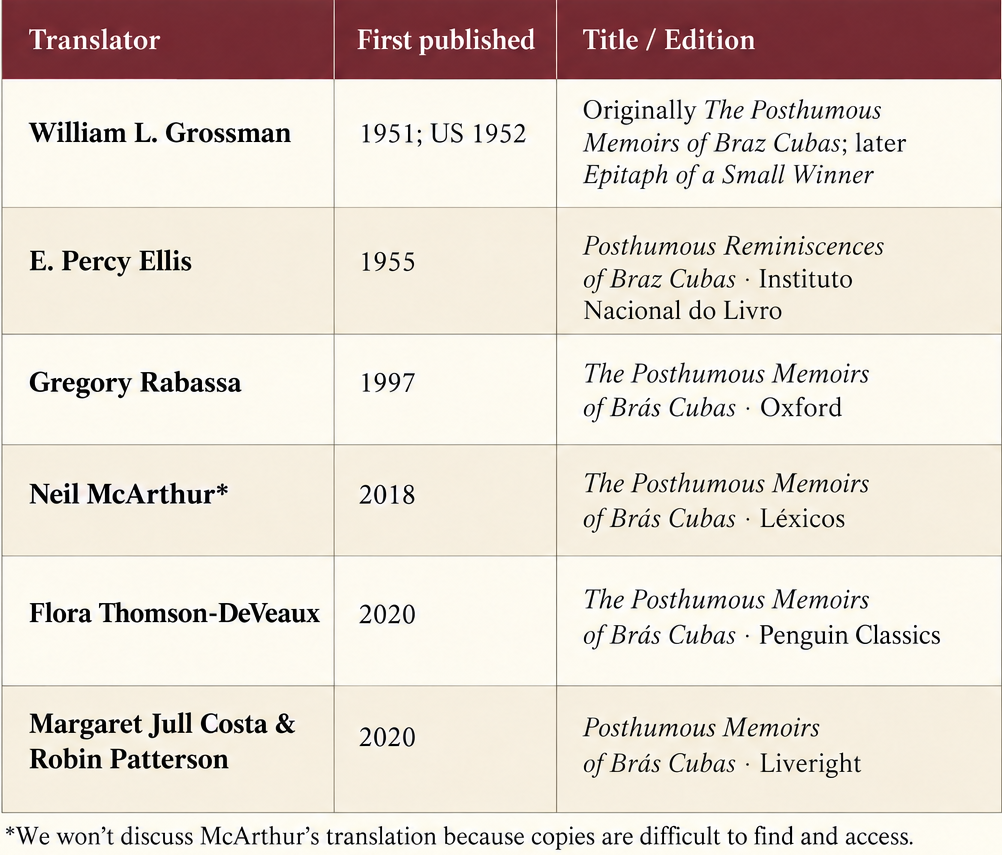
There are six main translations of Brás Cubas into English.
Translation is its own entirely complicated question; how does one move meaning between languages in the right way? Well, there’s a complicated and lengthy canon on the theory of translation. The earliest translators in the western tradition were translating ancient texts and then Holy Scriptures from Greek to Latin. From early on, the idea of translating something word for word kind of went out the window. Saint Jerome, patron saint of translators and the subject of my all-time favorite Caravaggio painting, in his Letter to Pammachius, No. 57 (395AD) "freely announced" that "in translating from the Greek - except of course in the case of Holy Scripture, where even the syntax contains a mystery - I render not word for word, but sense for sense" (Robinson 1997a: 25). Most translations, in some way, adhere to this idea. There are different theories as to how this is best undertaken, and we’ll just go over the relevant ones and discuss their implications through concrete examples in Brás Cubas. But the sense for sense type of translation is what forms the basis for American linguist Eugene Nida’s theory of dynamic equivalence, which posits an equal value between the source text and the target text, the text being translated and the translation. My favorite theorist on this is German critic Walter Benjamin, who rejects the idea that translation is about replacing an original text in another language and conveying meaning within it. And that there is no such thing as a neutral translation. Whatever choice a translator makes, it goes to show Benjamin’s argument that translation is in fact a creative process all on its own in which languages disclose their affinities with one another.
Then, Hans Vermeer came up with the skopos theory; skopos is ‘purpose’ in Greek. Accordingly, the theory contends that the translation’s function differs from the original, making it so that the translator has to adapt their approach based on their goal of translating it. For example, William Grossman, the first person to bring Brás Cubas to the Anglophone world brought it under the title Epitaph of a Small Winner, and its publication intended to persuade English speaking audiences of the existence of a brilliant 19th-century author writing metafictional fiction, which was all the rage during what we can basically categorize as the beginning of the postmodern period, which really valued work that demonstrated the constructed nature of systems. One of the quotes on the back of this edition comes from writer Louis de Bernieres, who writes that “[Machado] is a really post-modernist writer.” Grossman, in the attempt to find acceptance for this novel within a translation-averse market, attempted to domesticate the translation by smoothing the prose into what he believed his target audience might want, fluent mid-century American English, and, like we mentioned, even changed the title.
Three years after Grossman’s translation, Percy Ellis was commissioned by the Brazilian Instituto Nacional do Livro to translate Brás Cubas. In contrast to Grossman, who aimed for commercial appeal, Ellis focused on the formal equivalence side of translation. His translation is titled Posthumous Reminiscences, which can be seen as an attempt to lean into the text’s 19-century context. Being rather academic and government-backed, the translation didn’t have an extensive international distribution and it is now considered more of a collector’s item than a contended translation.
Then 40 years or so pass until Gregory Rabassa––a legendary translator of works such as Gabriel García Márquez’s Cien Años de Soledad, Julio Cortazar’s Rayuela, and Jorge Amado’s Terras do Sem Fim––translated Machado’s text as part of the Oxford World Classics series. Rabassa employed a sparse and rather abrupt style that mirrored Machado’s, and scholar Camila Matos Venesiano Nunes in her doctoral thesis for PUC-SP, argued that Rabassa’s is more faithful or closer to the original than Thomson-DeVeaux, who we’ll discuss next.
In 2020, two translations were published simultaneously: the Penguin Classics version translated by Flora Thomson-DeVeaux and the Liveright one by Margaret Jull Costa and Robin Patterson. In contrast to Grossman’s domesticized version, Thomson-DeVeaux’s foreignizes the text in the sense that Lawrence Venuti defines as “an ethnodeviant pressure on those (cultural) values to register the linguistic and cultural
difference of the foreign text, sending the reader abroad” (Venuti 1995: 20). For Thomson-DeVeaux, it was important to capture the malleability of Machado’s syntax, which, in its form, contains the possibility for irony, misdirection, and innuendo. And which also creates a particular rhythm. Hers is the only one which has each chapter begin on its own page like the original version in Portuguese and which has extensive endnotes that provide sociohistoric context such as that of the Valongo market in the chapter “The Whip.” She treats Machado’s linguistic, formal, and semantic idiosyncrasies as an essential part of the reading experience––and since I think that form is primary even though context and the reader’s response are also essential for understanding a text––I deeply appreciated the endnotes in guiding, bolstering, or challenging my readings and research.
Jull Costa and Patterson’s translation as said by Amherst Spanish and Portuguese Tal Goldfajn for the LA Review of Books, “seems to be primarily concerned with accessibility for contemporary Anglophone audiences, which at times involves editing punctuation, expanding phrases for clarity, [and] trimming back flourishes.” Although Goldfajn doesn’t express which translation she prefers, it seems that she prefers Thomson-DeVeaux’s for the same reason I do: Thomson-DeVeaux focuses on the preservation of form and her notes provide readers historical awareness, the former which is key to tuning into the tension held in the taut connection between the linguistic and philosophical elegance and the cruelty of the text, which is, in turn, unlocked by the cruelty. Returning to Benjamin, he compares the act of translation to piecing back a broken vase. He writes, translation is a chain of metaphors that function like
Fragments of a vessel which are to be glued together must match one another in the smallest details, although they need not be like one another. In the same way a translation, instead of resembling the meaning of the original, must lovingly and in detail incorporate the original's mode of signification, thus making both the original and the translation recognizable as fragments of a greater language, just as fragments are part of a vessel.
I think that Thomson-DeVeaux’s translation best pieces together the fragmented vessel of Brás Cubas, and helps the reader do that with her end-notes.
So, now let’s look at a quick, iconic, and concrete example that shows the difference in how translators approach a sentence whose polysemic or multifaceted meanings depends on its syntax, its sentence structure. The sentence, the basically opening joke of the novel, which happens in the first paragraph of its first chapter, in Portuguese goes:
“Eu não sou propriamente um autor defunto, mas um defunto autor…” - even if you don’t understand portuguese, you can see how the joke depends on the switching of the words “autor defunto” and “defunto autor.”
Grossman translates it as: “I am a deceased writer not in the sense of one who has written and is now deceased, but in the sense of one who has died and is now writing.” (31 words) This is a pretty clear overexplanation, three times as many words to say the same thing. Beyond verboseness, it takes all the playfulness out of the joke. We can be grateful for his enthusiasm for and efforts to bring Machado to Anglophone audiences while recognizing the domesticized nature of the prose.
Rabassa writes, “I am not exactly a writer who is dead but a dead man who is a writer.” (16 words) Although not as wordy, Rabassa still loses the word play involved with the reverse parallelism that holds the cheekiness of Machado’s writing. Better, but let’s see if the others can do even better.
Thomson-DeVeaux has it, “I am not exactly an author recently deceased, but a deceased man recently an author.” (14 words) Now we’re getting closer, although she adds “recently,” which is perhaps implied by Machado’s original but not actually verbally present, and the syntactical parallel both with the words and the presence of the comma between both clauses is the best so far.
Jull Costa and Patterson will finish us off with: “I am not so much a writer who has died, but a dead man who has decided to write.”(19) Honestly it reminds me the most of the Grossman translation–-and it has the second highest amount of words––, and adds the “decided to” which is not in Machado.
I point out the difference in exact words just to illustrate the differences, but, following Benjamin, I don’t believe that the point is to take it word for word, so the additions don’t necessarily bother me. Thomson-DeVeaux’s here wins for me because it is the closest in form, because it “lovingly and in detail” recreates the sense of Machado’s sentence. The punctuation, the low word count, and the paralleling of words most closely does the job of translation, capturing the essence of the text and giving an afterlife, which brings us to our conclusion.
VI. Conclusion: The Afterlives (and Relative Obscurity) of Machado’s Novel and Why It’s Still Worth Studying
My goal with this video and in teaching this text is to continue to revitalize the afterlife of Machado and his novel. In “The Task of the Translator,” Benjamin writes: “Just as expressions of life are connected in the most intimate manner with the living being without having any significance for the latter, a translation proceeds from the original. Not indeed so much from its life as from its "afterlife" or "survival" [Überleben].” In her article titled “Afterlives: The Case of Machado de Assis,” American philosopher Susan Sontag writes, “Surely Machado would be better known if he hadn’t been Brazilian.”
In my video that I mentioned before about Brazilian writers, I discuss how most of Brazil’s authors aren’t well known for an array of reasons. Many people cite untranslatability, especially when it comes to more experimental works like João Guimarães Rosa’s novel Grande Sertão Veredas, which I’m planning on teaching next year in my book club as well since a new translation by Alison Entrekin entitled Vastlands: The Crossing is due to come out in January. I actually already have an advanced reader copy of it, but I’m not going to say anything about it just yet, to keep up the mystery and motivate you to join the Book Club. That was a bit of a tangent, but I think it’s a cop-out to appeal to untranslatability, especially when it comes to Machado and Brás Cubas, which has been translated six times officially, as we discussed. Moreover, after political motivation and literary goodwill, we also have lots of translations of writers like Jorge Amado. So, the Portuguese language is not in and of itself a decisive barrier as to what is published in the anglophone market, which is the largest linguistic and publishing market in the world.
On top of the colonial exploitation of Brazil, the history and nature of the publishing market have much more to do with it. Brazilian literature didn’t get a chance to develop as much as European traditions because ‘Brazil’ as we know it didn’t come into existence until its formal independence 1822, much much later than European countries and later than many (although not all) Latin American countries as well. Moreover, the huge amount of enslaved peoples whose labor was exploited but minds and bodies were not served and nourished and whose descendants have often been relegated to extreme poverty in return, left Brazil with a largely illiterate population for long after its independence. Even though the first publishing of Brás Cubas happened in 1881, the same year as James’ Portrait of a Lady, Twain’s The Prince and the Pauper, and Whitman’s Leaves of Grass, the first time it arrived to an English speaking context was only 70 years(!) after that, with Grossman’s 1950s translation. Those decades where Machado remained in Lusophone circles entails years upon years without readers, reviews, curricula, and the possibility for literary influence in the English-speaking world.
When the Latin American Boom hit the United States some decades later in the 1960s and 70s, it focused largely on Spanish-language writers, unfortunately sidelining Brazil and Lusophone literature. Additionally, even though Brás Cubas is very innovative, the associations that arise with Machado being an 19th-century writer may have tinged his possibility to works to rise to fame as they should have because the Boom was explicitly seeking ‘modern’ and ‘innovative’ works and were therefore potentially biased against older authors. This overlooking, by the way, is an issue for all of Brazilian literature, not just Machado. Yes, there were critics here and there who admired Machado and read Brazilian literature, but this institutional marginalization is one of the reasons why everyone knows García Márquez and not Machado de Assis.
I am trying to help Machado’s work find its true place in a worldly canon. And I have hope, because as Sontag suggests, “with enough time, enough afterlife, a great book does find its rightful place. And perhaps some books need to be rediscovered again and again.”
Sontag closes her New Yorker piece with this wonderfully sharp observation: “It doesn’t seem much of a compliment to say that this novel, written more than a century ago, seems—well, modern. Isn’t every work that speaks to us with an originality and lucidity we’re capable of acknowledging inevitably one that we then want to conscript into what we understand as modernity? Our standards of modernity are a system of flattering illusions, which permit us to selectively colonize the past, as are our ideas of what is provincial, which permit certain parts of the world to condescend to all the rest. Being dead may stand for a point of view that cannot be accused of being provincial. Surely [The Posthumous Memoirs of Brás Cubas] is one of the most entertainingly unprovincial books ever written. And to love this book is to become a little less provincial about literature oneself” Although she finishes with what I interpret as a statement on the merits of reading ‘outside the canon,’ if you would, her question about the categorization of modernity is what I want to focus on. Our tendency to want to conscript a text into what we understand as the modern, as she puts it, is a category mistake––where we conflate the recognition of a text’s vitality for a sense of it being modern, of belonging to our world. Brás Cubas is so lucidly alive, its radiance shines through, precisely because of the way it responds to its own historical moment and temporal setting. (Mind you, Machado was writing this novel about a time prior to his own birth so lest you believe I am contradicting the statement I made in my close reading video, I am referring here to the context within the novel––of which the context of writing was an inheritor.) Anyway, we don’t need a text to function as a mirror image of ourselves in order for its quality to be retained. Were we to believe that, we’d be like Narcisses and novels, Echoes. And we know the tragic endings of those characters. Being worldly is not just about reading outside of our comfortable wheres, but stretching into other whens, too. The past is not obsolete or flat––it is, if we follow Derrida, very much still here and present. That’s not to create a sense of timelessness, but to demonstrate that being haunted by Brás Cubas’ ghost is maybe exactly what you need right now.
So, let’s read on!