
inside my books and databases: how I read closely
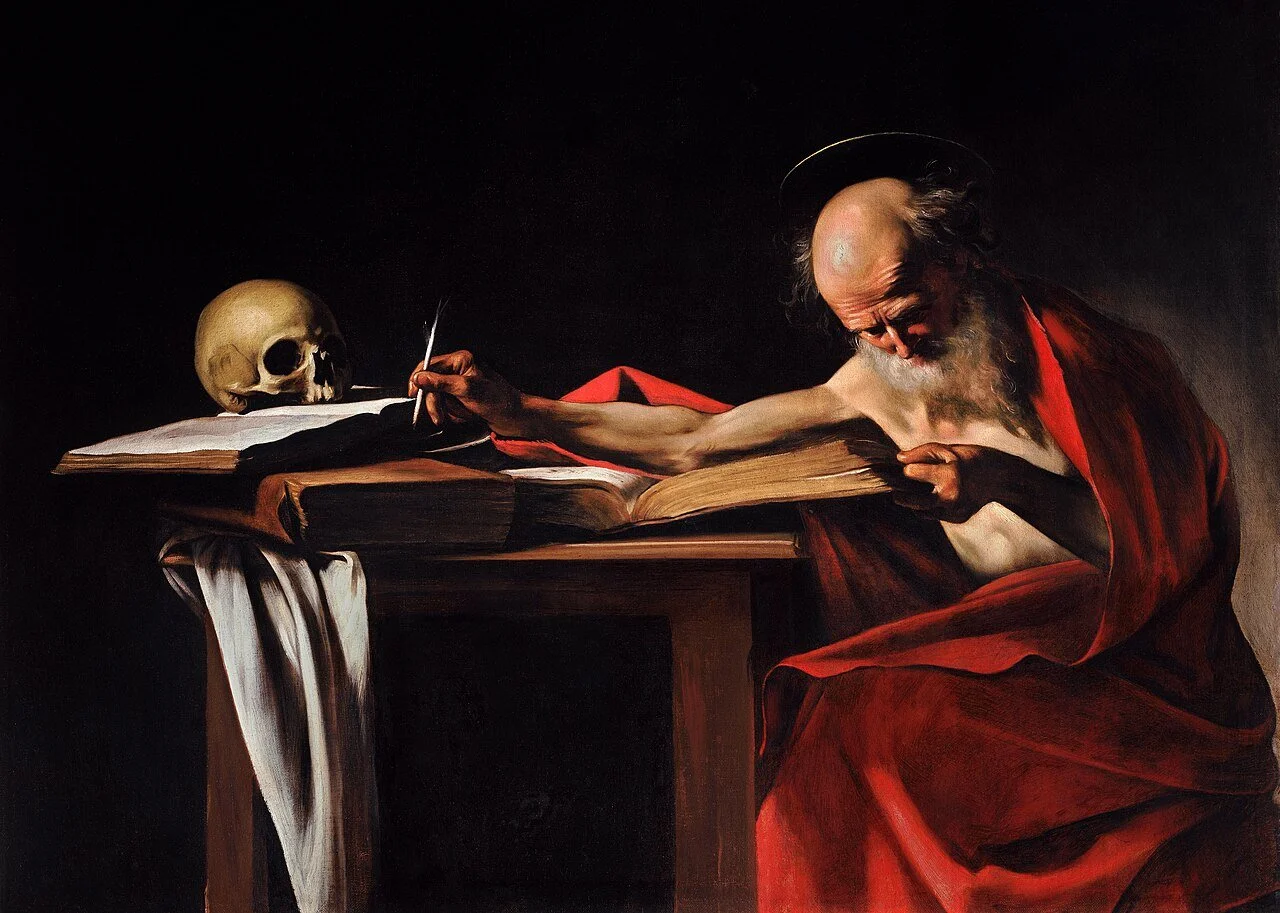
I.Every Time You Read A Book It’s an Opportunity to Have a Discussion
Although nowadays we see reading as a solitary act, I actually think it’s an opportunity for community, and communion. Historians believe storytelling began with visuals, and the red ochre painting in the Leang Karampuang Cave in Sulawesi, Indonesia, which is believed to be at least 51,000 years old.
Once the voice and gestures came into the picture (ha!), we move into the era of oral storytelling. Since the trace of oral narratives belongs to memory, which the ancient Greek playwright Aeschylus deemed “the mother of all wisdom” in his tragedy Prometheus Bound, there isn’t an exact date to which we can point as its beginning. Of course, all verbal storytelling began with oral tradition. The oldest datable story appears to be the 10,000 year-old tale of the indigenous Ngadjonji tribe about the creation of Australia's lakes and mountains. In fact, some countries’ literary and storytelling traditions rely still on oral storytelling, such as of some indigenous Australian communities; West African countries like Ghana, Mali and Senegal who rely on griots or Jalis to preserve history and moral lessons, who are similar to Ireland’s seanchaí. And the Epic of Gilgamesh and Homer’s Iliad are some of the oldest recorded written stories we have. Homer’s epics, as well as most texts before the 17th century, were read aloud due to various reasons such as the burden of understanding scriptio continua––the fact that texts were written in a continuous line of letters without spaces between words, punctuation, or capitalization (McCutcheon 21). Verbalization therefore functioned as a method of decoding in the ancient Greek and Roman worlds. Given the automatically social nature of a text by way of its form, reading to oneself was seen as peculiar, secretive, perhaps even rude or worrisome.
In Saint Augustine of Hippo’s Confessions, there’s a famous passage where he’s astonished by how his mentor, Saint Ambrose, read to himself: “But when Ambrose used to read, his eyes were drawn through the pages, while his heart searched for its meaning; however, his voice and tongue were quiet” (qtd. In McCutcheon 3). By the same token, Plato, arguably the most influential philosopher in the western tradition, wrote dialogues, because that, to him, represented how knowledge is best shared. Reading being characterized as a solitary phenomenon, is therefore relatively modern. I think that by annotating, you make every book you read into a conversation you’re having across time and space, with people centuries, worlds, and traditions away. That communion is one of the most beautiful and important aspects of reading to me, besides the fact that I find joy and pleasure in the act of reading and enjoy the beauty of linguistic manipulation. Today, I’m talking you through my annotation and notetaking system.
II. Annotating While Reading
I always read with a pencil in hand. I don’t subscribe to the idea that a book is precious and ought not to be touched. I do have certain editions of books––such as an 1899 copy of Don Quixote given to me by one of my dearest friends and old copies of Alexander Pope’s translations of Homer––that I won’t write in because they’re special objects to me. But otherwise in my paperbacks (and even hardcovers), I will write, at times like a maniac, in my copies of texts. Pencil over pen, personally. Because although I don’t believe that writing in a book is defacing it by any means, writing in pencil feels more… friendly. Less intense.
I’ve gone through many different annotation systems, including stages in my life where I went absolutely wild with the post-it flags. Nowadays, I typically don’t use post-it flags except for when I am lesson planning within a particular text, such as I am doing right now in Machado de Assis’ Posthumous Memoirs of Bras Cubas for the Book Club I’m starting in November. If you’re interested, join the waitlist in the description. You can learn more on alifeofreading.org.
My note-taking system consists of four parts.
Marginalia – notes in the margins + some ideas for library/kindle books
Book index – important ideas and notes for later
Further research – other texts, ideas, or references
Postreading notes – A short reading response
(1) For my marginalia or in-page notes, I generally stay consistent but am not perfect. My annotations happen fluidly within the moment, and I think that so long as your current and your future self understand your system, that’s all you need. I underline any passage that sticks out to me, for any reason, like:
I find the language beautiful or otherwise striking
I find it funny
I think it’s important
It’s surprising
The criteria here isn't strict, underlining is the least discriminant part of the systems.
I circle names, dates, and other important short-form information. Next to passages that I think are even more important than merely striking, maybe because of plot progressions, symbolism advancement, or character development, I put three lines. I used to star those, but now I save the stars because when there’s a passage that I find really, really important––maybe 2–5ish passages per text (that’s not a hard range, but I just mean the count of stars is much lower than the rest). The three line and star distinction I got from Ben McEvoy’s annotation system, and it’s helped me distinguish those very important passages––which I usually identify in rereads or reflections. This system doesn’t feel laborious, by the way, it’s so second nature for me by this point that I don’t really even think about it as I read.
You, personally, don’t have to take this as something to remember exactly either. This is the system I’ve found that works for me, but the whole point of an essay like this is to demonstrate a system of annotation that works for me in my independent study and research and explain how it works and why. So, try it out, see what you like and don’t like, and keep experimenting until you find a system that helps you in your endeavors.
Unfortunately, if you read library books, you cannot do on-page marginalia. I’m happy to see you taking advantage of the library, especially when maybe you’re not sure whether you want to own that book or not. In that case, you can use post-it notes and/or sheets of paper to write your thoughts alongside the page numbers and then put them into a notebook, or something like that.
It’s going to be a bit more work like this, or perhaps just seems like that but is a different kind of work since that’s not the system I’m used to. If you have a kindle, you can highlight relatively well, but the writing feature––at least on my paperwhite kindle from 2020, which was my savior for reading when I was living in Peru last year, and which I still find a very okay or at least doable replacement for a book when I can’t procure a physical copy due to finances, travel, or other limitations––is very shabby. If you’re using a kindle, I’d highly recommend you also use a separate notebook and keep a system like something like what I described above. However, you can find a way even if you don’t own the physical copy of the book. Also, if you’re using a kindle or listening to audiobooks, you should know about Libby, an app where you can connect your library card to your phone for audio and kindle books and by way of your phone onto your actual kindle. This is not sponsored, Libby is just a wonderful app everyone in the United States should know about.
Perhaps a natural follow-up––albeit slight tangent––here to address is: Are audiobooks reading?
I, myself, listen to audiobooks and, of course, read physical books. The books I listen to are almost always nonfiction/informational––Sheldrake's Entangled Life or Stein's Custodians of Wonder are some personal favorites. I have listened to some Stephen King novels as well, though. Those are books I don't feel I need to spend longer periods with, contemplating individual lines, phrases, passages, and ideas. I'm there more for the story/info than the arguments, form, and literary aspects of it all. By the same token, I know that when I only listen, it's much easier for me to lose total focus as opposed to when I read a physical copy of a book. In a way, you can see it as actually being harder to read a book deeply as an audiobook for that reason. But so when it comes to philosophy or literature, I need to have the book in hand in order to annotate. (For some books––Ulysses, for example––I’m listening to audiobooks while I read the physical book to help me understand better.) You can also use the audio-physical book combination for other tricky books narratively such as ones with lots of stream of consciousness, like Gabriel Garcia Marquez’s Autumn of the Patriarch or Virigina Woolf’s To The Lighthouse.
I still consider the books I've listened to as books I've read. I don't think there's anything wrong per se in classifying listening to a book as 'reading' it. Especially because I am cognizant of the fact that different people learn better differently. However, I acknowledge that it's plainly a distinct level and type of engagement with the work, and to what extent one feels one has truly 'read' a text after having listened to it versus having physically(visually? kinesthetically?) read it is up to one's own definition and sense of satisfaction with the subsequent comprehension and analysis.
(2) Book index: As I’m reading, whenever there comes a passage that I think is important or that makes me think of something I want to add to one of my databases or I think are important moments in the text that I want to remember later when I’m researching and writing on certain topics, I write the page number and a small phrase or quote that will help me remember that passage. I usually save one whole page for this, and depending on how dense the text or how much I want to refer back to in the future, I’ve used something like three pages or just a quarter of a page. Neither is right or wrong, it’s merely how it worked out in that case. I got this tip from Adam Walker’s video.
(3) Back Cover On the page next to it or the back cover, I write references: texts I should read based on texts that were mentioned, or philosophical topics to research later. Anything that I’d want to buy a book about or read an entire book on.
(4) Postreading Notes In “On Books,” by Michel Montaigne, the father of the essay, he describes a specific end-of-reading habit, which I have adopted myself. Apparently, due to his forgetfulness, Montagine would occasionally pick up a book he had thoroughly read years prior and begin pursuing it. In order to not waste his time re-reading books he didn’t intend to, he began writing a final annotation on the back or endpages. They have two specific elements: the date he finished reading the book, and his judgment of it––his overall opinion that captured the “character and general idea” of the text he had formed while reading it. When picking up a new book, he could flip to the end of a volume and see what he thought. I believe that our reactions to a text are incredibly important for understanding and analyzing that text. Having the opportunity to transcribe and later encounter a raw, unvarnished account of your own thoughts of a book can be relatable, is often funny, sometimes cringe-inducing, but always useful. It’s a very low-stakes and simple ritual to incorporate in your reading routine that, at best, will help your reading journey and/or research, and at worst, capture your feelings on a cover. I’ve been doing this for a bit now, and I think it’s a good practice, useful especially when I’m wading in literary criticism and want to remember what I authentically thought rather than what the papers around me are importing into my thoughts.
III. Journaling & Rereading
I am working at establishing a more consistent journaling routine on the books I read. Ben McEvoy in his wonderful video about marginalia discusses his practice of setting aside a time each week to choose a passage from whatever text he’s engaging with and reflecting on it. I’ve done that a number of times, and would like to incorporate it into my research praxis; however at this moment, it’s not a very consistent part of my routine. When I have written about passages, I’ve done it on my computer, and I think it would be nice to do it by hand. I write my diaries by hand, make my bullet journals by hand (which I’ve been making by hand for about 5 years now and if you’re interested in my bullet journals which are my personalized agendas, let me know in the comments and I can make it), and have started to do my creative writing by hand, and this is another activity that also makes sense for me to do by hand.
I do have a commonplace journal where I currently only have notes from the lectures I took with Emily Wilson through the American Academy of Poets on the Iliad and her translation of it. A commonplace journal, by the way, is a type of journal where you take notes like you did in school on topics of your interest. People set them up differently, and since I am deeply curious about many things in the world––how a car works, how planes manage to fly, snakes, the Brazilian amazon, movies and directors, etc––I have every intention of doing more. However, my hands are full between everything I’m doing right now, so it’s one of the hobbies/interests I have on the back-burner shall we say. I would also like to put it into a weekly practice.
A micro re-reading trick I took from Ben McEvoy was that whenever I pick up a book, I do a sort of micro re-read by looking through the pages in the book before where I left my pencil/my current page. As for re-reading generally, I would love to re-read more and even feel tempted to challenge myself to, as soon as I finish reading a text, simply begin rereading it again. But I feel conflicted by the pull to read as many books as possible, so I’m still not sure I’m up for the challenge yet.
IV. Databases
I also adopted this system from the video by Adam Walker that I referred to earlier. I have three types of encyclopedias I keep:
A Topical Encyclopedia
An Encyclopedia of Persons
Timelines of Centuries
The first two are organized alphabetically and are double-columned. The alphabetization helps finding things quickly, and the double-column looks more official, like a dictionary or index, to me. The timelines are chronological and also double-columned. These databases and the commonplace journal are where the book index that we make while we’re reading really comes in handy. For example, when I was reading Augustine’s Confessions earlier this year, I was thinking a lot about the word and idea of ‘abyss,’ so I took note of that. And if a page had a quote I thought would be important for this encyclopedia, I would note (TE, topic encyclopedia) next to the book index entry.
Once you finish reading, you can record those entries into their respective encyclopedias.
For the Topical Encyclopedia, I started putting topics in as I thought about them and as they came up in my reading. Like I mentioned, since reading Lenz by Georg Büchner, I have been philosophically intrigued by the idea of the ‘abyss.’ So, whenever I’m reading, I’ve been on the lookout for a mentioning of ‘abyss,’ and when I was reading Augustine’s Confessions earlier this year, I saw many mentions of it. So, I took note of them in my book index like I just showed you and added them into the ‘abyss’ section I created. I ended up writing a newsletter on the topic that developed out of a journaling session on the quote. So, you see how the ecosystem of annotation is all meant to feed into each other to help you as you continue to learn. Because this database is still very much a work in process, there are many entries I am missing. And this is one of those documents that never really fully reaches an end because the more I read the more perspectives I get to record about these ideas.
I structure it like this: like I said, the topics are in alphabetical order. Then, within each topic, the topic usually gets a simple dictionary definition, though not always. Then, I have citations of passages from books I’ve read related to this topic. For example, for epic poetry, I have the definition from poetryfoundation.org followed by a quote from Nietzsche on the epic meter, a quote from Ben McEvoy then from one of his videos, then from Aristotle’s Poetics. That way, I gather many sources on the same topic, and when I go to research or write about that topic, I have a variety of starting points and/or perspectives already recorded.
2. The process is similar for the Encyclopedia of Persons. If I see a name mentioned in a book, for instance when I was reading Aristotle’s Poetics, he mentioned Aeschylus, whose name I had heard before but who I never did deep research into. So, I took note of his name in my book index and wrote PE (people encyclopedia) next to it. I added him to the database, which is organized alphabetically by last name, when I finished the book and did some research. Or, for example, after I read Macunaíma, I did research into the author, Mário de Andrade, and on the text, and now if I’m going to write about him or want to refresh my memory, I have what I think are the most salient facts. Wikipedia, britannica, and other basic databases are good for this kind of infroamtion, but what I have honestly found the most useful are the biological notes that come in editions of the books themselves. For example in the biological preface Oxford World’s Classic edition of The Castle, I learned a lot more about Kafka in a few pages than I found with online research (I recently published what turned out to be a very long video on Kafka, so if you’re interested in my thoughts on him, check it out!. That’s not to say they’re always better, but if you can find a copy with some kind of timeline or information like that when you’re creating your own database, I have found those particularly useful. The subcategories I have under each person are: Life. / Works. / History. and Quotes. I’m not 100% consistent with putting quotes in both the topical and persons encyclopedia, but if there’s a quote, like the Aeschylus one that is more important or isn’t about a topic I’m thinking about right now, I’ll add it in this database rather than the other one. Again, I’m not super puritanical about these, so long as their systems help me more than frustrate me, then they’re doing what they’re meant to do. The scope and topics of your databases should serve your purposes, and these systems can be easily adapted to whatever discipline you’re working in.
It’s the case with both topics and persons that I don’t always have the time to research everything in the moment I want to. So, as I scroll, you’ll see some very bare or even empty entries, and those are ones I haven’t yet completed but want to remember to. It’s a perpetual progress, really. There is no end point to gaining knowledge and accruing information; or maybe there is, but I am very far from it in my journey of learning.
3. Timelines of Centuries: This is a pretty straight-forward aspect of my notes, too. I have 4 timelines for centuries, currently, and will eventually expand them further. But for now I have a BC timeline then 18th–20th century timelines. Each timeline is its own document. In the timelines, I wrote out each year, so in the 19th–century timeline, we have 1800–1899 and the categories I have for each year are: Events. / Poetry. / Prose. / Drama. / Philosophy. / Theology. and / Persons. It’s interesting to see how things align, when people die and are born relative to each other. Sometimes when I read things, the worlds feel so distinct that I would never make the connection, for example, that Kierkegaard was born the year before Percy and Mary Shlley run away together in their love affair. So, you find some funny coincidences or just allow things to meld into your brain in what I see as a more comprehensive view of that century. By the way, the categories I have listed here are ones that are the most relevant to me. If you study history rather than literature and philosophy primarily, maybe your categories will be something like Wars. / Treaties. / Borders. – I don’t know. But I developed these categories because they’re what I’m interested in. The scope of your databases should serve your purposes. Maybe all you care about is philosophy, then just do that. Maybe all you care about are scientific discoveries, then just do that. These systems can be easily adapted to whatever discipline you’re working in. Or whatever your general research interests are.
You may be wanting to ask me to send copies of my encyclopedias in the same way your classmate shares the quizlet they made. And I’m going to have to tell you no. And it’s not for gatekeeping purposes, I am happy to share my entire system as I just did and any specific information I gathered on any person or topic. I won’t share the document for two reasons. (1) In the same way that the person who made the quizlet learned and improved their memory of the topic by making it, making the encyclopedia will do the same for you. You have to do your own research and make your own flashcards (or in this case databases); it’s part of the process of studying and learning. (2) These encyclopedias are very particular to me. While most of the entries are in English, some are written in Portuguese, others in Spanish, and others in French. Some contain shorthand only I understand, and that’s because they’re systems meant to serve me. So even if your system totally replicates mine in its form––which is perfectly fine––when you write it yourself, it will become your system. And that sense of ownership is important when it comes to your intellectual work. So, please feel free to read this essay over and over and do exactly as I do. So long as you’re doing it and it makes sense for you, you’re doing it right.
IV. Conclusion
As I read, I actively react to the text I’m reading. After I read, I use the text I read to inform my broader research projects and attempts to gain knowledge. That’s why I developed these systems of annotation and data.
I want to close by saying that I know this can all seem like a lot. I will tell you that when I began making my databases earlier this year (I’ve been annotating for years but I only started the databases this year), I was super overwhelmed and had what felt like 1 million tabs open trying to figure out everything all at once. My advice would be to go one data-base at a time, starting with whichever feels the most interesting, or the easiest. Create three documents, leave one open. Maybe you’re reading a book right now or one you’ve just finished: check if there’s biological information or a timeline that you can start with. And do as much or as little as you want: in the end, it’s your learning that’s being served by your work.
So let’s read on!